

Imported vs. Domestic Nylon in SLS 3D Printing: What’s the Real Difference Between PA12 Powders?
Both are nominally the same PA12 powder — so what exactly are you paying for? A practical breakdown of powder quality, part performance, color, consistency, certifications, and cost.
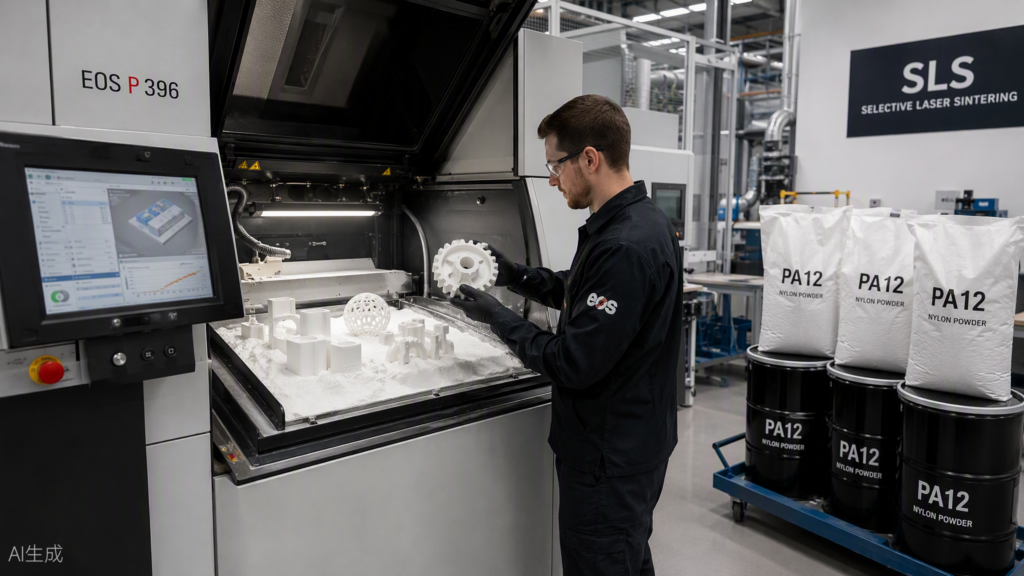
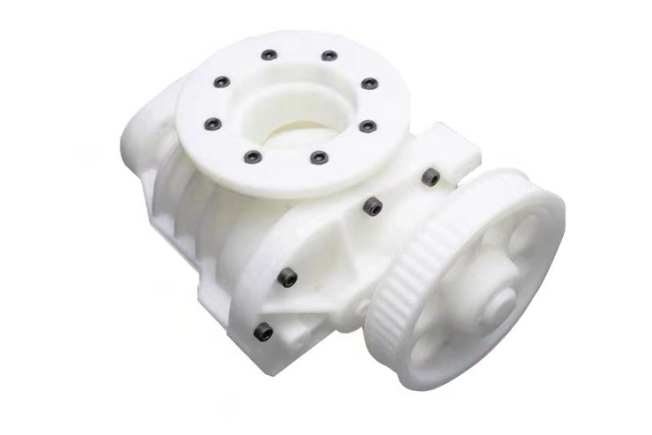
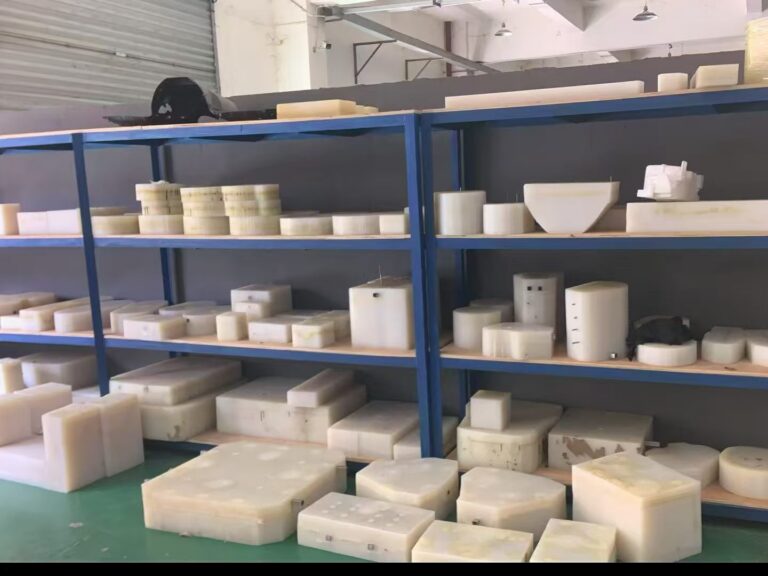
An SLS build chamber opened after printing: white PA12 nylon parts emerge from the powder cake.
If you’ve ever requested a quote for SLS nylon 3D printed parts, you’ve probably been asked a question that sounds simple but isn’t: “Imported nylon or domestic nylon?” The price gap can be 30–50%, yet both materials are nominally the same thing — PA12 (polyamide 12) powder for selective laser sintering. So what exactly are you paying for when you choose an imported powder like EOS PA2200, Evonik VESTOSINT, or BASF Ultrasint over a Chinese domestic PA12 from suppliers such as Wanhua, TPM3D (Precimid), or Farsoon (FS series)?
This guide breaks down the real, practical differences — powder quality, part performance, color, consistency, certifications, and cost — so you can specify the right material for your project instead of guessing.
First, Why PA12 Dominates SLS Printing
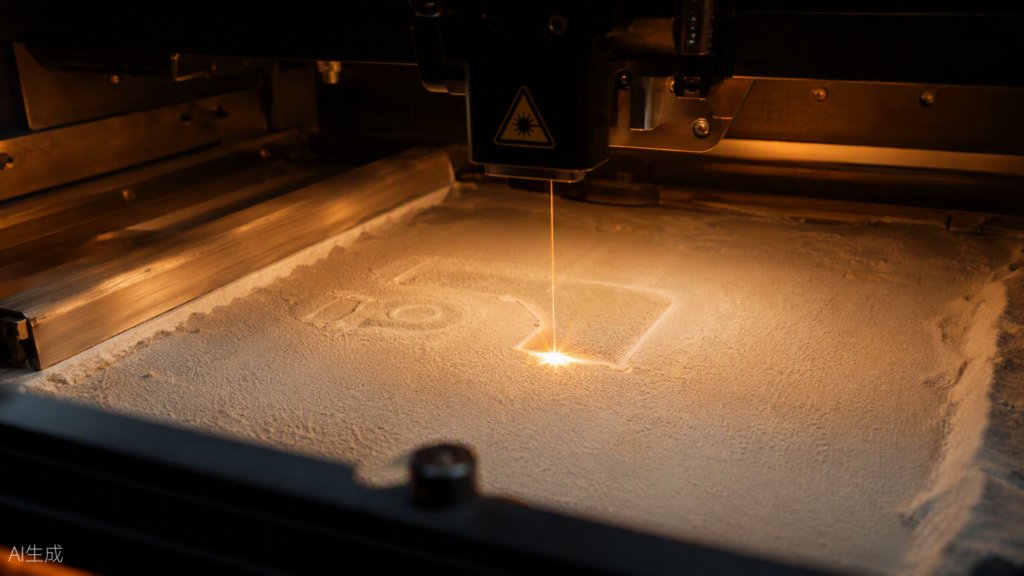
The SLS process: a laser scans and sinters thin layers of PA12 nylon powder, no support structures needed.
Selective Laser Sintering builds parts by scanning a laser across thin layers (0.10–0.15 mm) of nylon powder, fusing each cross-section without any support structures. PA12 became the industry’s workhorse — accounting for well over half of all SLS material consumed — because of a rare combination of properties:
- Tensile strength of 45–50 MPa with excellent fatigue resistance (100,000+ bend cycles)
- Low moisture absorption (~0.7%) compared with PA6 or PA66, giving superior dimensional stability
- High powder flowability and low static, critical for uniform powder spreading
- Heat deflection around 115–171 °C depending on grade and load
- Chemical resistance against oils, greases, fuels, and hydraulic fluids
Both imported and domestic powders share this same PA12 chemistry. The differences live in the details of how the powder is made and controlled.
The 6 Real Differences Between Imported and Domestic PA12
1. Powder Morphology: Sphericity and Particle Size Distribution
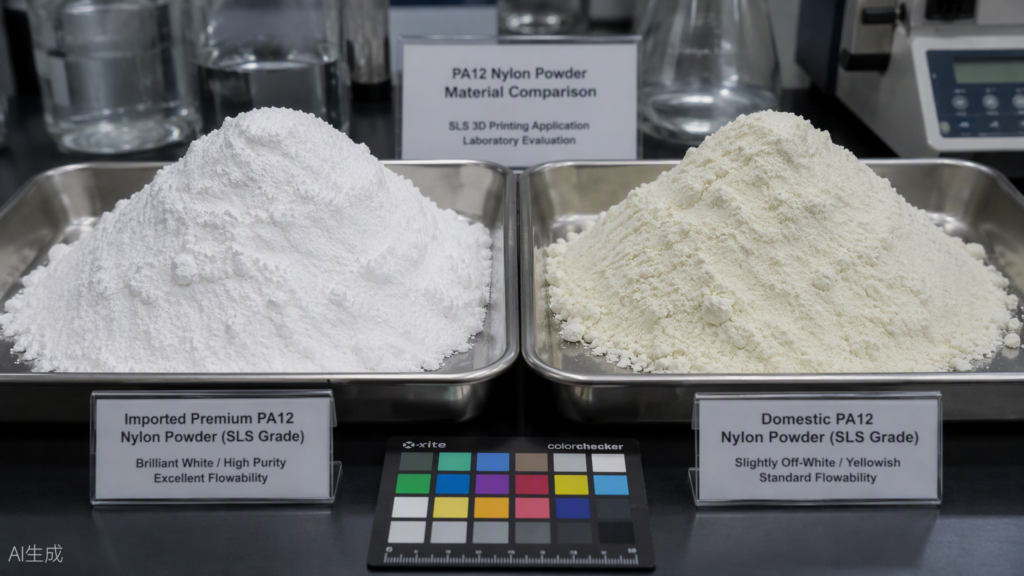
Lab comparison: premium imported PA12 powder (brilliant white, left) vs. a domestic PA12 powder (slightly off-white, right).
SLS powder quality starts at the particle level. Premium imported powders are produced by precipitation processes that yield highly spherical particles with a narrow size distribution (typically 50–90 μm, well-graded). This translates directly into smooth, even powder layers and consistent sintering.
Domestic powders historically relied more on grinding processes, which produce irregular particle shapes and wider size distributions — leading to rougher part surfaces and occasional powder-spreading issues. This gap has narrowed dramatically: leading domestic producers now offer precipitation-grade spherical powders with flowability genuinely comparable to EOS PA2200, while budget-grade ground powders still exist at the bottom of the market. When buying domestic, ask whether the powder is precipitation-processed or ground — it matters more than the country of origin.
2. Color and Whiteness
This is the most visible difference. Imported PA12 (EOS PA2200, for example) prints in a bright, neutral white that takes dye evenly and looks clean as-delivered. Many domestic powders print slightly off-white or yellowish — largely due to differences in antioxidant packages used to stabilize the powder at sintering temperatures (~178 °C melting point, bed temperatures of 170–180 °C).
For functional parts destined to be dyed black, painted, or bead-blasted, the color difference is irrelevant. For consumer-facing white parts or precise color matching, imported powder still holds an edge.
3. Mechanical Performance and Batch Consistency
On datasheet numbers, good domestic PA12 now matches imported grades: tensile strength in the 45–55 MPa range, elongation at break around 15–20%, and similar HDT values. Some domestic suppliers even claim superior toughness at the same price point.
The more meaningful difference is batch-to-batch consistency and process window. Imported powders come with decades of process parameter databases, tightly controlled refresh ratios (virgin-to-used powder mixing), and predictable behavior across machines. Domestic powders can require more parameter tuning per batch, and quality varies more between manufacturers — and between the premium and budget tiers within the same manufacturer. A reputable print shop compensates with incoming QC and first-article verification, but the engineering effort is real.
4. Powder Reuse and Refresh Rate
SLS economics depend heavily on powder recycling: unsintered powder is sieved and blended with fresh powder for the next build. Higher-quality powders tolerate more reuse cycles before oxidation degrades part quality. Premium imported powders and top domestic grades (e.g., TPM3D’s Precimid series) advertise recovery/reuse rates of 80–90%, while lower-grade powders may need a higher fresh-powder ratio — quietly eroding the upfront price advantage. Always compare cost per finished part, not cost per kilogram.
5. Certifications and Traceability
For medical, food-contact, and aerospace-adjacent applications, this is often the deciding factor. Established imported materials carry documented biocompatibility (EN ISO 10993-1, USP Class VI), food-contact compliance (EU 2002/72/EC, FDA 21 CFR), and full batch traceability with certified datasheets. Domestic premium lines are increasingly certified too, but documentation depth and international recognition still generally favor the imported brands. If your part needs a paper trail for regulatory review, verify certificates by name — don’t assume.
6. Price and Supply Chain
Imported PA12 powder typically runs ¥150–200+ per kg in the Chinese market (roughly $60–100/kg internationally), while domestic equivalents run ¥100–150 per kg, with budget grades lower still — some suppliers quote less than half the imported price. Domestic powder also wins on lead time, minimum order quantities, and communication speed. For high-volume printing operations, that 30–50% material saving is decisive; for a single mission-critical prototype, it’s noise.
Side-by-Side Summary
| Factor | Imported PA12 (EOS PA2200, Evonik, BASF) | Domestic PA12 (Wanhua, TPM3D, Farsoon, etc.) |
| Powder morphology | Spherical, narrow PSD, precipitation process | Premium grades now comparable; budget ground powders still rougher |
| As-printed color | Bright neutral white | Often slightly off-white / yellowish |
| Tensile strength | ~45–50 MPa | ~45–55 MPa (premium grades) |
| Batch consistency | Excellent, large parameter databases | Good at premium tier; variable at budget tier |
| Powder reuse rate | ~80%+ | 80–90% on premium lines; lower on budget lines |
| Certifications | Full ISO 10993 / FDA / food-contact documentation | Growing coverage; verify per grade |
| Price | ¥150–200+/kg ($60–100/kg) | ¥100–150/kg; budget options below |
| Lead time / MOQ | Longer, importer-dependent | Fast, flexible, local support |
So Which Should You Choose?
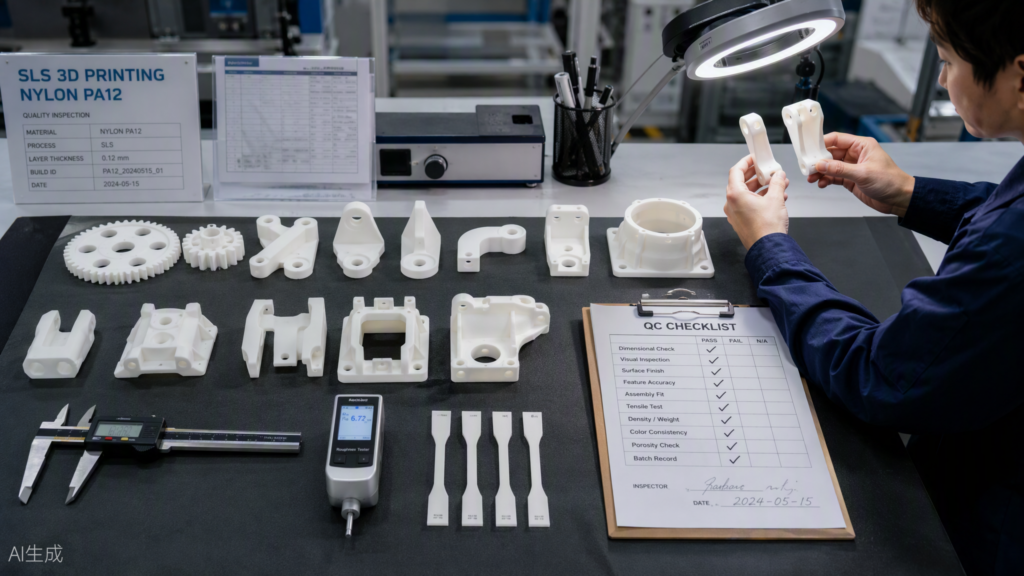
Quality inspection of SLS nylon PA12 parts: dimensional checks, tensile specimens and a batch QC checklist.
Choose imported PA12 when:
- Parts will be used white/as-printed for customer-facing presentation models
- You need documented biocompatibility or food-contact certification
- The application is safety- or fatigue-critical and you want maximum process predictability
- Your customer specification names the material (e.g., “EOS PA2200” on a drawing)
Choose domestic PA12 (premium tier) when:
- Parts are functional and will be dyed, painted, or otherwise finished
- You’re running medium-to-large batches where material cost drives the budget
- You need fast turnaround and flexible reordering
- Your supplier provides per-batch test reports and first-article inspection
Practical rule of thumb: the printer and the process engineer matter more than the powder’s passport. A well-maintained machine, correct drying (80 °C, 6–8 hours), controlled bed temperature (170–180 °C), high-purity nitrogen atmosphere (≥99.9%), and disciplined powder refresh management will produce excellent parts from either source — and a sloppy shop will ruin expensive imported powder just as easily.
Post-Processing Levels the Playing Field
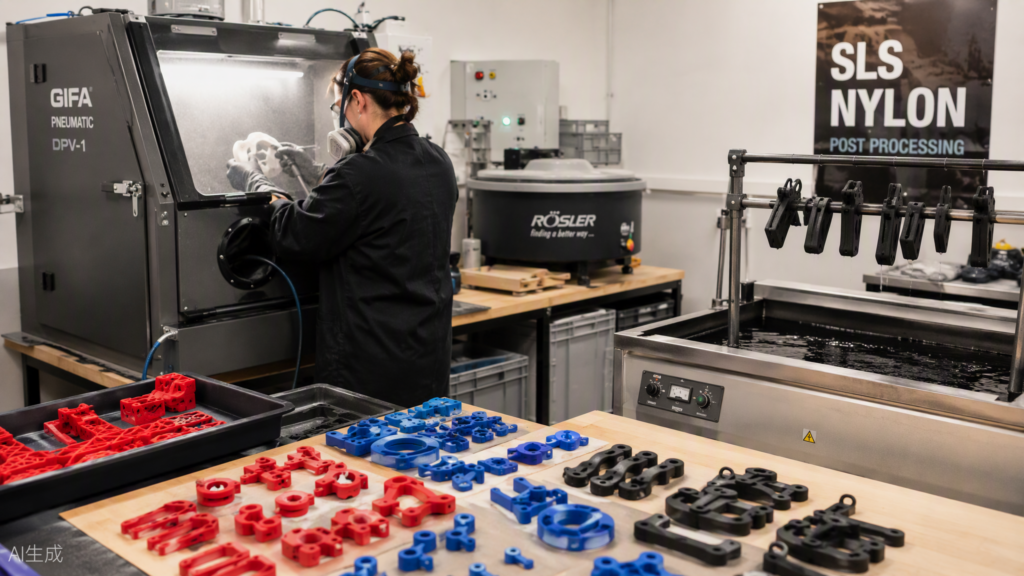
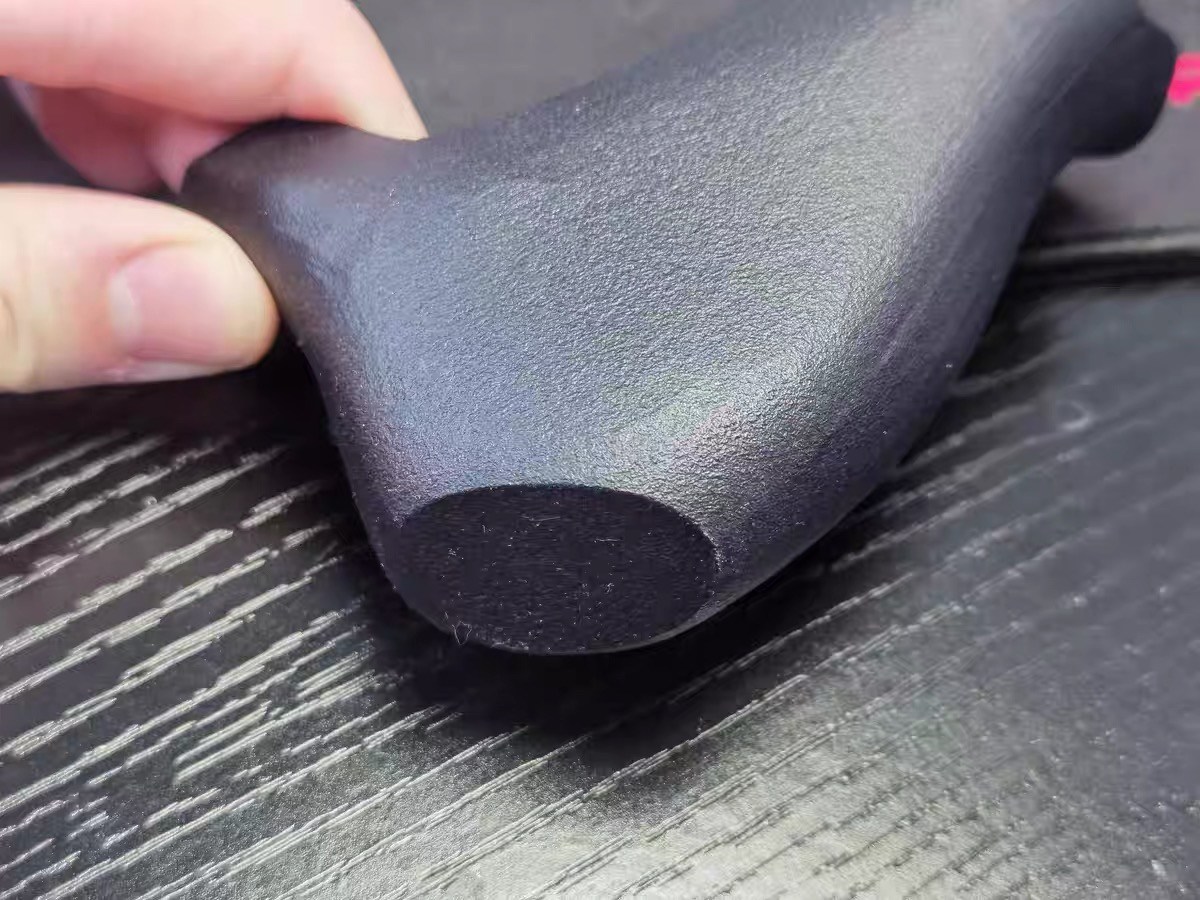
Post-processing station: bead blasting, dyeing and tumbling give SLS nylon parts a finished, colored surface.
Much of the visible gap between imported and domestic parts disappears in finishing. Bead blasting evens out surface texture; dyeing (black being the most forgiving and most popular) completely masks any base-color difference; vapor smoothing and lacquering seal the surface and reduce moisture uptake. If your parts are destined for finishing anyway, paying the imported-powder premium buys you very little that your customer will ever see.
The Bottom Line
The honest answer to “imported or domestic?” in 2026 is no longer “imported, obviously.” Premium domestic PA12 has closed most of the performance gap at 60–70% of the price, while imported powders still justify their premium in certified, appearance-critical, and spec-driven applications. The right question isn’t which flag is on the drum — it’s which material grade, which certifications, and which print shop’s process control stand behind your parts.
Not sure which your project needs? Send us your CAD files (STEP/IGES/STL) and tell us the application, quantity, and any certification requirements. Our engineering team will recommend the right material grade — imported or domestic — with a transparent quote and free DFM review within 24 hours. Test coupons in both materials are available on request, so you can compare before you commit.
UtelyMachine — industrial SLS nylon 3D printing with both imported and premium domestic PA12 in stock. Visit us at www.utelymachine.com.