


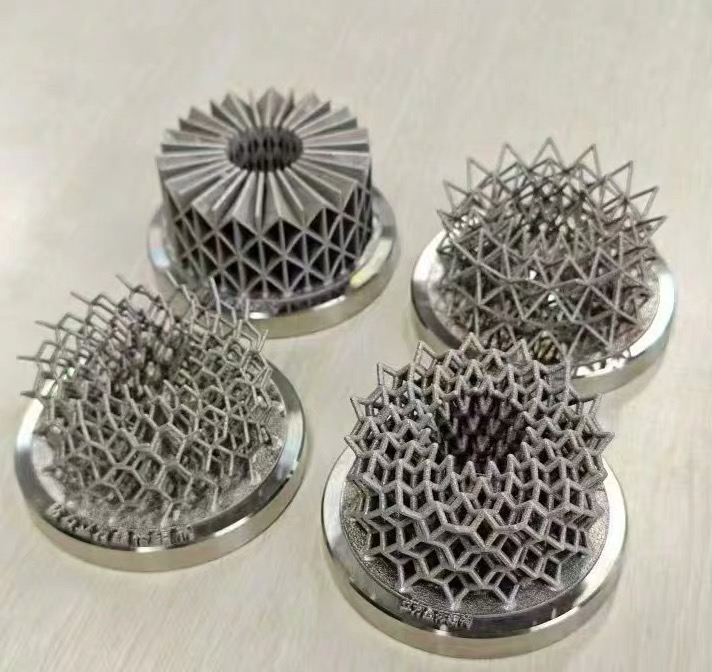
SLM Metal 3D Printing: Why Selective Laser Melting Is Rewriting the Rules of Metal Manufacturing
Fully dense parts straight from powder — the advantages, the materials, and the applications that make SLM the backbone of serious metal additive manufacturing.
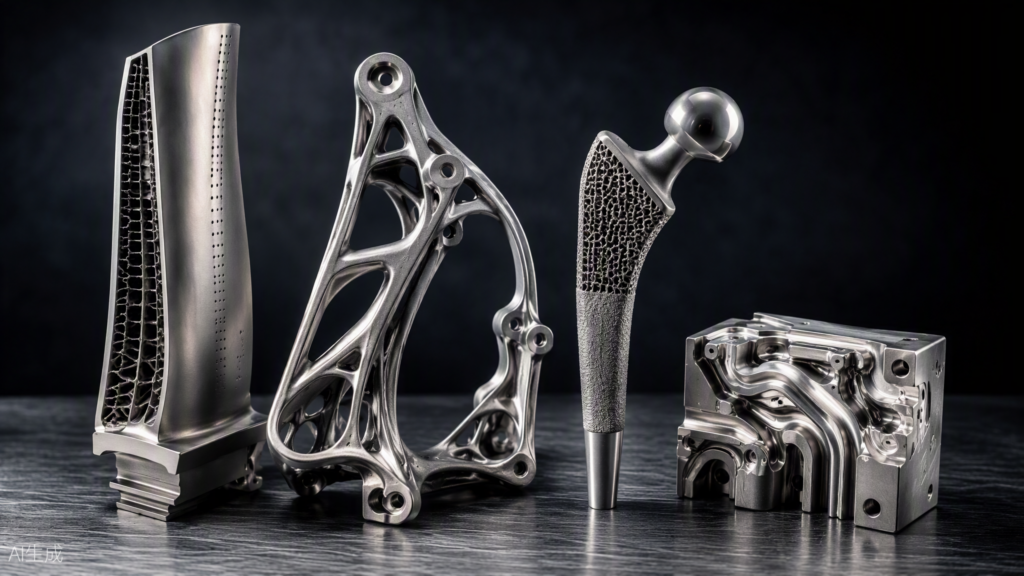
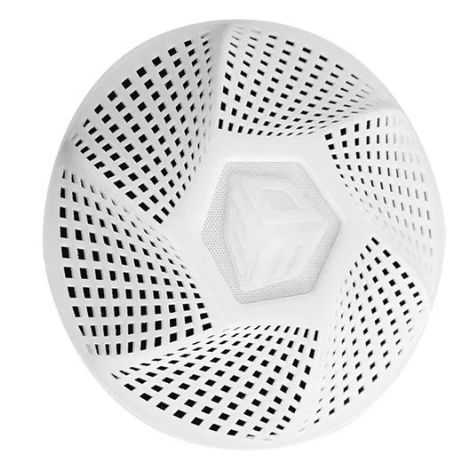
SLM-printed metal parts: a turbine blade, a topology-optimized bracket, a hip implant and a conformal-cooling mold insert.
Some manufacturing technologies improve on what came before. Selective Laser Melting (SLM) replaces the assumptions entirely. No molds, no cutting tools, no design concessions to the machine — a high-power fiber laser melts fine metal powder, layer by layer, into fully dense metal parts that match or exceed the mechanical properties of forged stock.
For engineers working in aerospace, medical, automotive, and tooling, SLM has moved well past “promising prototype technology.” It is now a qualified production process. Here is what it does, what it prints, and where it earns its keep.
How SLM Works — and Why That Matters
Inside a sealed chamber flooded with inert argon or nitrogen, a recoater spreads metal powder in layers just 20–60 microns thin.
A fiber laser scans each cross-section of the sliced CAD model, fully melting the powder into solid metal before the next layer descends. The oxygen-free atmosphere is not a luxury — for reactive metals like titanium, it is what stands between a flight-grade part and a contaminated one.
The result: parts reaching 99.9% material density, near-net-shape, straight off the build plate. Unlike sintering-based processes that need infiltration or heat treatment to reach full density, SLM parts emerge essentially complete — post-processing is a choice, not a requirement.
The Advantages That Make Engineers Switch
- Design freedom without penalties. Internal cooling channels, thin-walled lattices, organic topology-optimized shapes, consolidated assemblies — geometries that CNC machining and casting simply cannot produce. A bracket that was five machined parts becomes one printed part.
- Radical lightweighting. Lattice optimization routinely cuts component weight by 20–40% while preserving structural safety — the single most valuable currency in aerospace and motorsport.
- Near-zero material waste. Titanium and Inconel are brutally expensive, and conventional CNC machining converts 70–90% of the raw billet into chips. SLM uses only the powder the part needs; unfused powder is sieved and reused across multiple build cycles.
- Forged-grade performance. Rapid, controlled melting produces fine, uniform grain structures. Properly heat-treated SLM parts deliver fatigue strength equal to forged metal — the threshold that flight qualification demands.
- Speed to iteration. No tooling, no fixturing, no mold lead times. Design changes — a thicker lattice here, a wider channel there — go from CAD to testable metal in days instead of months.
- Tooling with conformal cooling. Mold and die inserts with cooling channels that follow the part contour — impossible to drill, trivial to print — cut cycle times and extend tool life.
The Materials That Matter
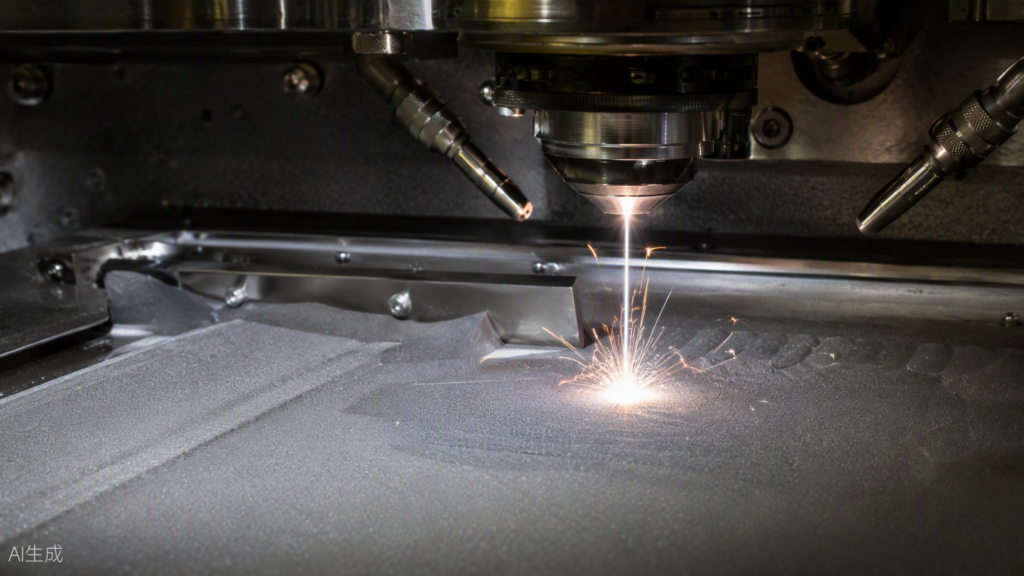
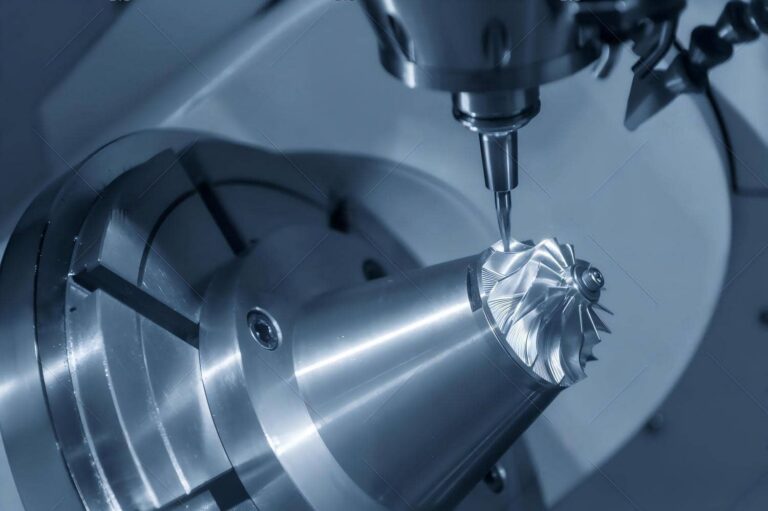
The SLM process: a fiber laser fully melting titanium powder inside an inert argon chamber.
Titanium Ti-6Al-4V (Grade 5) — the flagship SLM alloy. Tensile strength around 1080 MPa with an exceptional strength-to-weight ratio, corrosion resistance, and biocompatibility. The default for aerospace structures, racing components, and orthopedic implants — including porous lattice surfaces engineered for bone integration.
Inconel 718 & 625 (nickel superalloys) — built for punishment. Strength and oxidation resistance held at temperatures up to 650 °C make them essential for turbine blades, combustion chambers, exhaust systems, and hot-section engine hardware. They demand more laser energy and stricter thermal management, but nothing else survives the environment.
Stainless Steel 316L — the workhorse. ~640 MPa tensile strength, excellent ductility, and chloride resistance for marine hardware, chemical processing, food-grade equipment, and medical devices. Reliable to process, easy to finish.
Aluminum AlSi10Mg — lightweight with good thermal conductivity at ~460 MPa tensile strength. Aerospace brackets, automotive housings, and heat-management components where every gram and every watt matters.
Cobalt-chrome alloys — extreme wear resistance plus biocompatibility: dental frameworks, knee and hip replacements, and high-wear industrial components.
Tool steels (H13, 1.2709) — high hardness for molds, dies, and conformal-cooled inserts.
One practical note on economics: powder reuse is standard practice, but reactive powders like titanium demand strict atmosphere and oxygen control across cycles to keep chemistry — and certifications — intact.
Where SLM Parts Go to Work
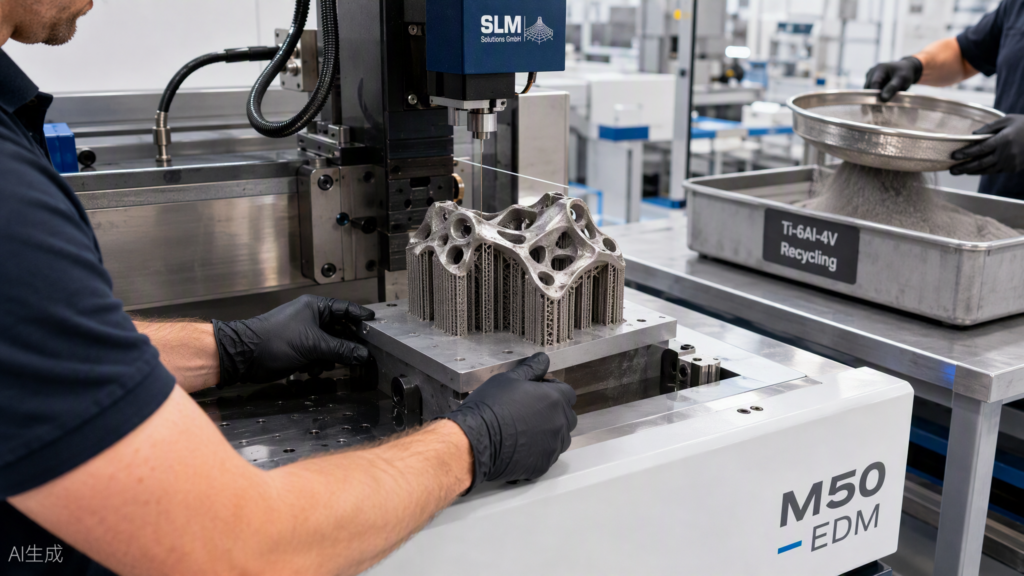
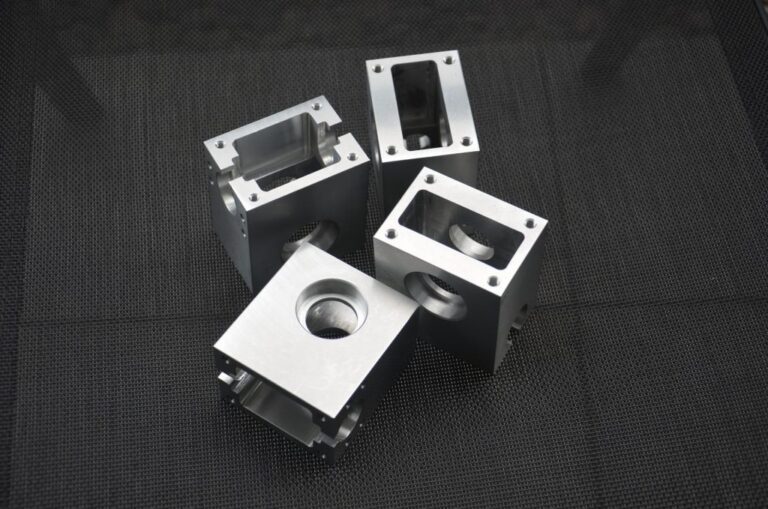
Post-processing: wire EDM removes the finished part from the build plate while unused titanium powder is sieved for reuse.
- Aerospace & space: airframe brackets, satellite fixtures, hydraulic manifolds, turbine blades — consolidated, lightweighted, and qualified for flight.
- Medical & dental: patient-matched titanium implants, bone scaffolds with porous integration surfaces, dental frameworks, surgical tooling.
- Automotive & motorsport: racing components, heat exchangers, lightweight structural parts where development cycles are measured in weeks.
- Tooling & mold making: conformal-cooled injection mold inserts that slash cycle time.
- Energy & chemical processing: Inconel components for turbines, valves, pump casings, and impellers that live in heat and corrosion.
An Honest Word on the Limits
SLM is not magic, and credible planning accounts for its constraints: parts are welded to the build plate and need support structures (removed by wire EDM or machining);
overhangs below ~45° require support; as-printed surfaces are rougher than machined ones;
And build orientation matters — anisotropy means strength and fatigue behavior differ between vertical and horizontal directions. Residual stress, porosity, and cracking are managed through parameter optimization, scan strategy, and post-build heat treatment. None of these are dealbreakers; all of them are reasons to involve process experts early.
The Bottom Line
SLM turns metal powder into production parts with a combination no other process offers: forged-grade density, near-zero waste on expensive alloys, total geometric freedom, and iteration speed that matches software, not tooling.
Whether the part is a titanium implant, an Inconel turbine component, or a mold insert with serpentine cooling veins, the question is no longer whether SLM can build it — it is how much you save when it does.