


Aluminum vs. Stainless Steel in SLM Metal 3D Printing: Properties, Applications, Post-Processing and How to Choose
AlSi10Mg or 316L? A practical comparison of properties, applications, post-processing routes and selection logic for laser powder bed fusion.
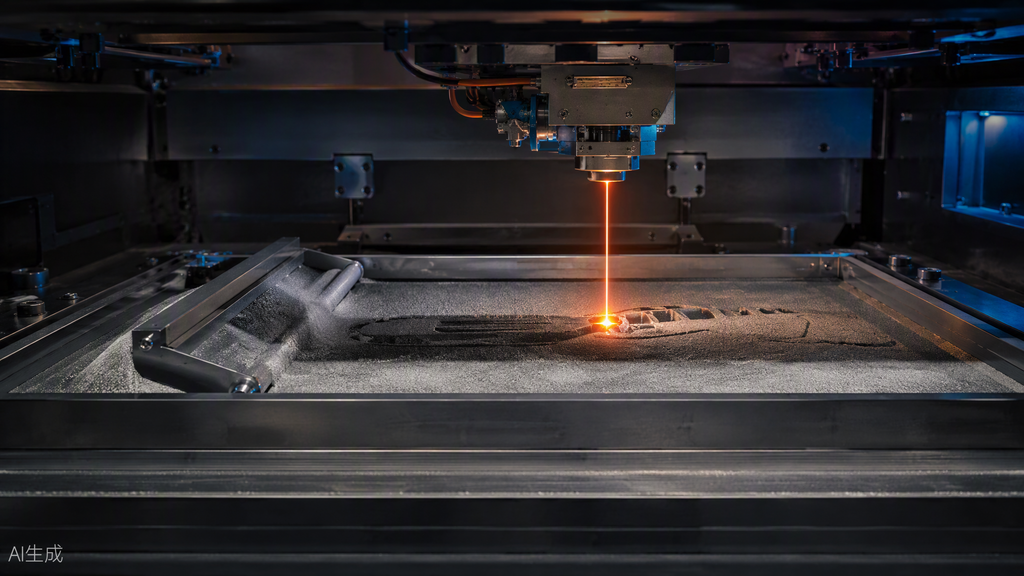
Inside an SLM printer: a laser selectively melts a metal powder bed layer by layer.
Selective Laser Melting (SLM) can turn metal powder into fully dense, near-net-shape parts — but the material you load into the machine changes everything: laser parameters, build risk, achievable strength, finishing route and final cost.
In this guide we compare the two most widely used SLM material families — aluminum alloys (typified by AlSi10Mg) and 316L stainless steel — covering their physical properties, typical applications, post-processing differences, and the strengths and weaknesses of each, so you can pick the right one for your next project.
1. How SLM Works — and Why Material Choice Matters
In SLM (also called laser powder bed fusion, LPBF), a high-power fiber laser scans across a thin layer of metal powder — typically 20–60 μm thick — and fully melts the cross-section of the part. The build platform then drops, a recoater spreads a fresh layer, and the process repeats hundreds or thousands of times until the part is complete.
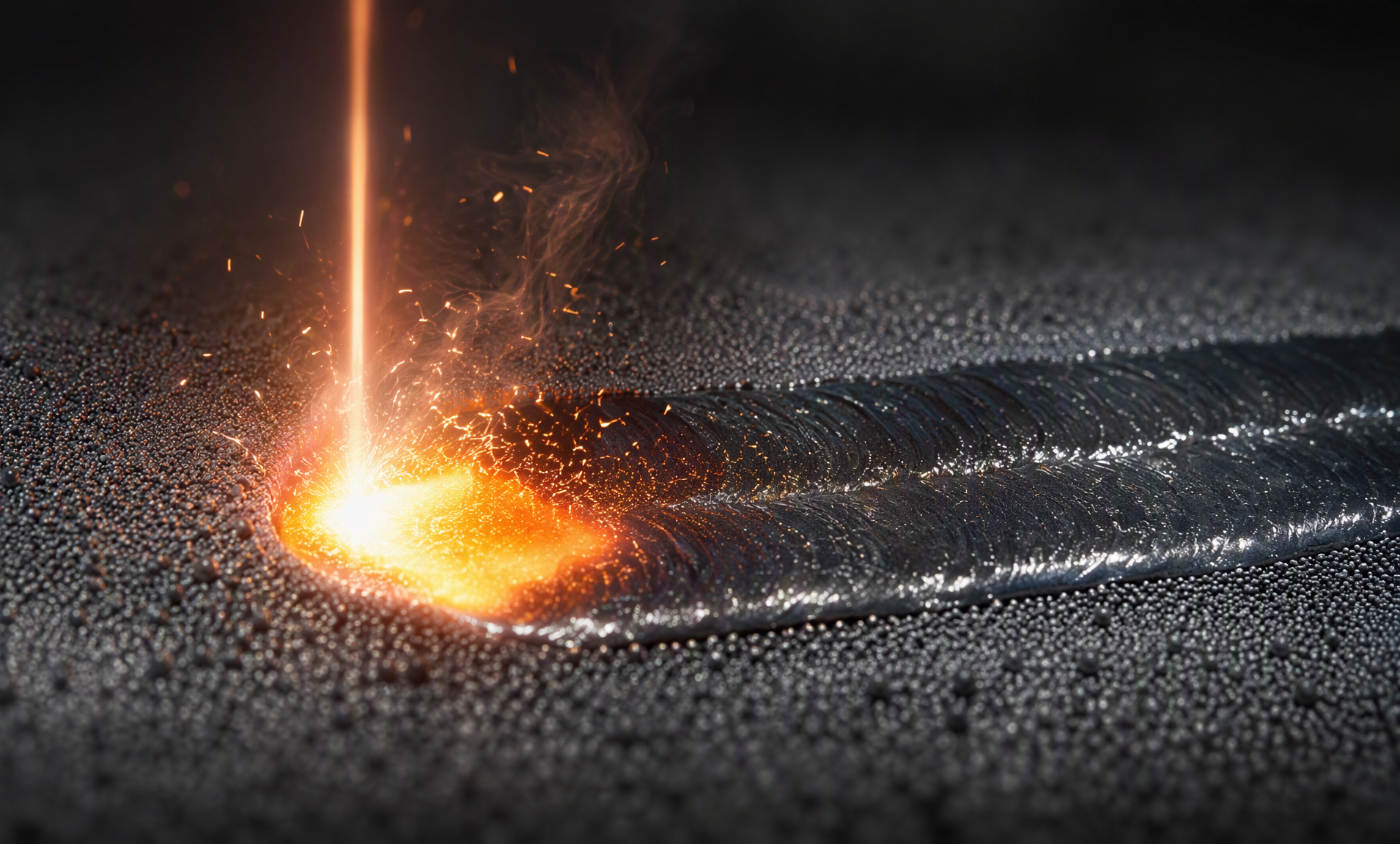
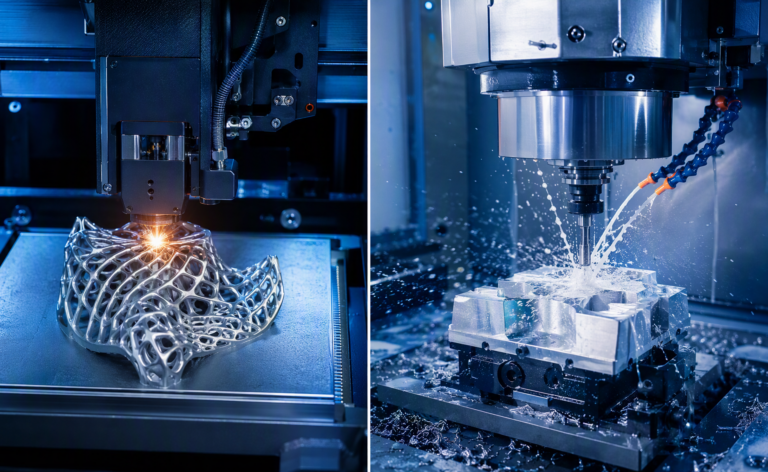
Close-up of the laser melt pool: the heart of the SLM process.
The physics inside that tiny melt pool is where the two materials diverge:
- Laser absorption. 316L steel absorbs laser energy readily (absorptivity around 0.35 at fiber-laser wavelengths), while aluminum alloys absorb far less (roughly 0.09) because of their high reflectivity. Aluminum therefore needs higher laser power and tighter parameter control to avoid lack-of-fusion or keyhole porosity.
- Thermal conductivity. Aluminum conducts heat about 9 times faster than 316L (~159 W/m·K vs. ~18 W/m·K). Heat escapes the aluminum melt pool quickly, which reduces residual stress but demands more energy input; steel keeps heat localized, raising residual stress and distortion risk.
- Melting range. Aluminum melts at roughly 830–870 K, versus 1658–1723 K for 316L — the steel process window runs much hotter and slower.
2. Property Comparison at a Glance
| Factor | AlSi10Mg (Aluminum) | 316L (Stainless Steel) |
| Density | ~2.68 g/cm³ — about 1/3 of steel | ~7.98 g/cm³ |
| Tensile strength | ~320 MPa after T6; as-built often 400+ MPa | 500–700 MPa as-built, excellent ductility |
| Strength-to-weight ratio | Excellent — the main reason to choose it | Moderate |
| Thermal conductivity | Very high (~159 W/m·K) | Low (~18 W/m·K) |
| Corrosion resistance | Good with anodizing; fair as-built | Excellent, especially after passivation |
| Heat resistance | Limited above ~150–200 °C | Good to ~400+ °C in service |
| Biocompatibility | Not used in implants | Widely used in medical & food contact |
| Powder cost | ~$90–200/kg | ~$80–150/kg |
| Print difficulty | Higher (reflectivity, oxidation, spatter) | Lower — forgiving, stable process window |
3. Aluminum Alloys in SLM: Strengths and Weaknesses
Where aluminum wins
- Lightweighting. At one-third the density of steel, AlSi10Mg is the default for weight-critical parts: topology-optimized brackets, drone and UAV frames, motorsport components, satellite structures.
- Thermal management. Its high conductivity makes it ideal for heat sinks, heat exchangers, cold plates and conformal-cooling inserts — parts where SLM’s freeform channels shine.
- Lower residual stress. Fast heat dissipation means less distortion and lower risk of cracking during the build.
Where aluminum struggles
- Print difficulty. High reflectivity and low laser absorption demand more powerful lasers and well-tuned parameters; oxide formation and spatter must be controlled with a stable, high-purity argon atmosphere.
- Limited high-temperature strength. Aluminum softens quickly above 150–200 °C, ruling it out for hot-section or high-load elevated-temperature parts.
- Surface and fatigue as-built. As-built surfaces are rough (Ra 8–20 μm typical), and fatigue-critical parts usually need machining or shot peening.
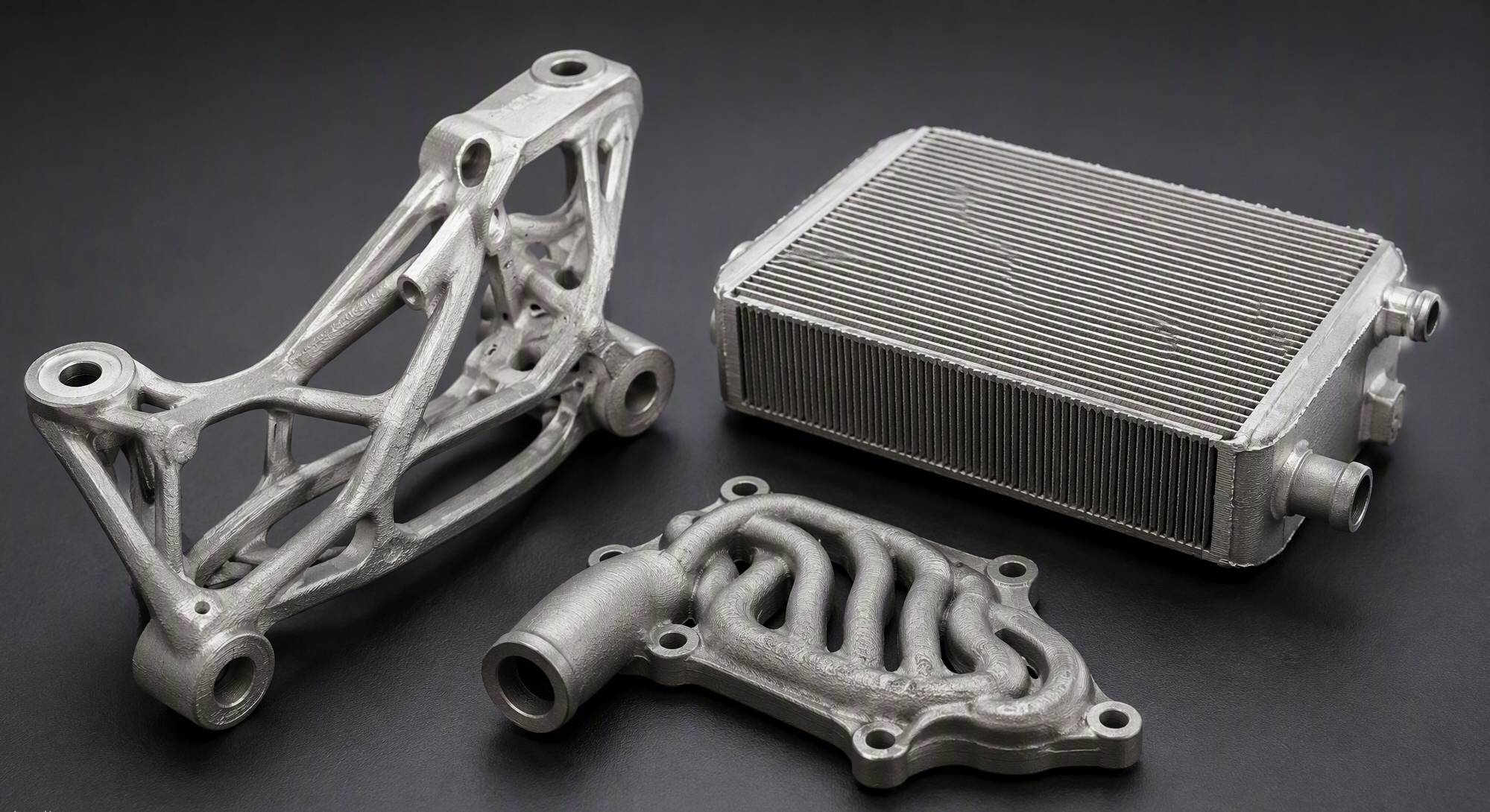
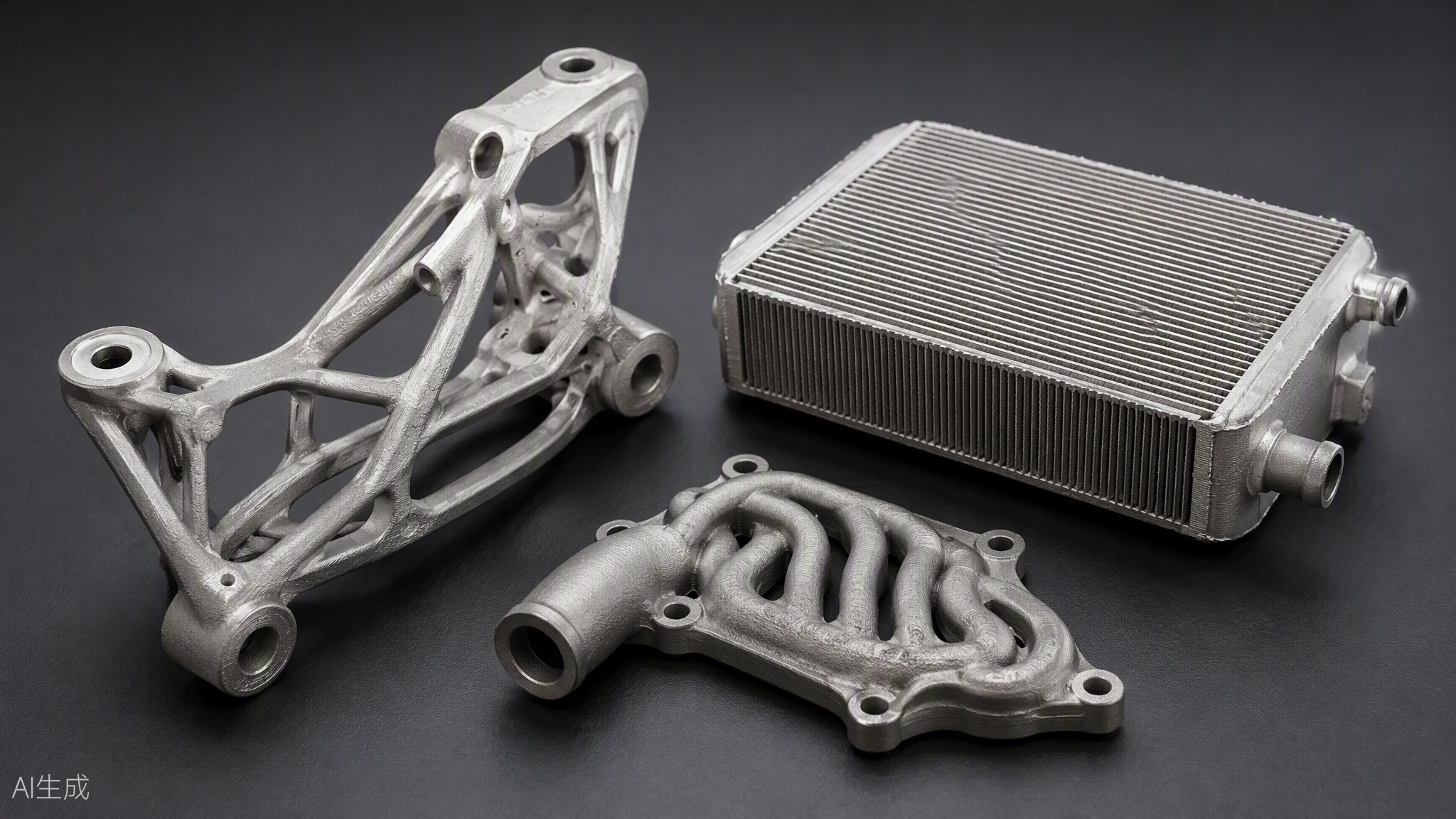
Typical SLM aluminum parts: topology-optimized bracket, heat exchanger and conformal-cooling manifold.
4. 316L Stainless Steel in SLM: Strengths and Weaknesses
Where stainless steel wins
- Mechanical robustness. 316L printed by SLM delivers 500–700 MPa tensile strength with excellent ductility and toughness — suitable for structural, load-bearing parts.
- Corrosion and chemical resistance. The go-to choice for marine, chemical-processing, food and pharmaceutical environments, especially after passivation or electropolishing.
- Biocompatibility. 316L is a proven medical material for surgical instruments, dental frames and orthopedic implants with osseointegrative lattice surfaces.
- Process stability. A wide, forgiving process window means higher first-time-right rates, lower scrap and shorter parameter development.
Where stainless steel struggles
- Weight. Nearly 3× the density of aluminum — a deal-breaker for airborne or weight-sensitive designs.
- Residual stress. Low thermal conductivity concentrates heat, producing higher residual stress, more support structures and a greater need for stress-relief heat treatment.
- Poor thermal spreading. Unsuitable for heat exchangers or thermal-management parts.
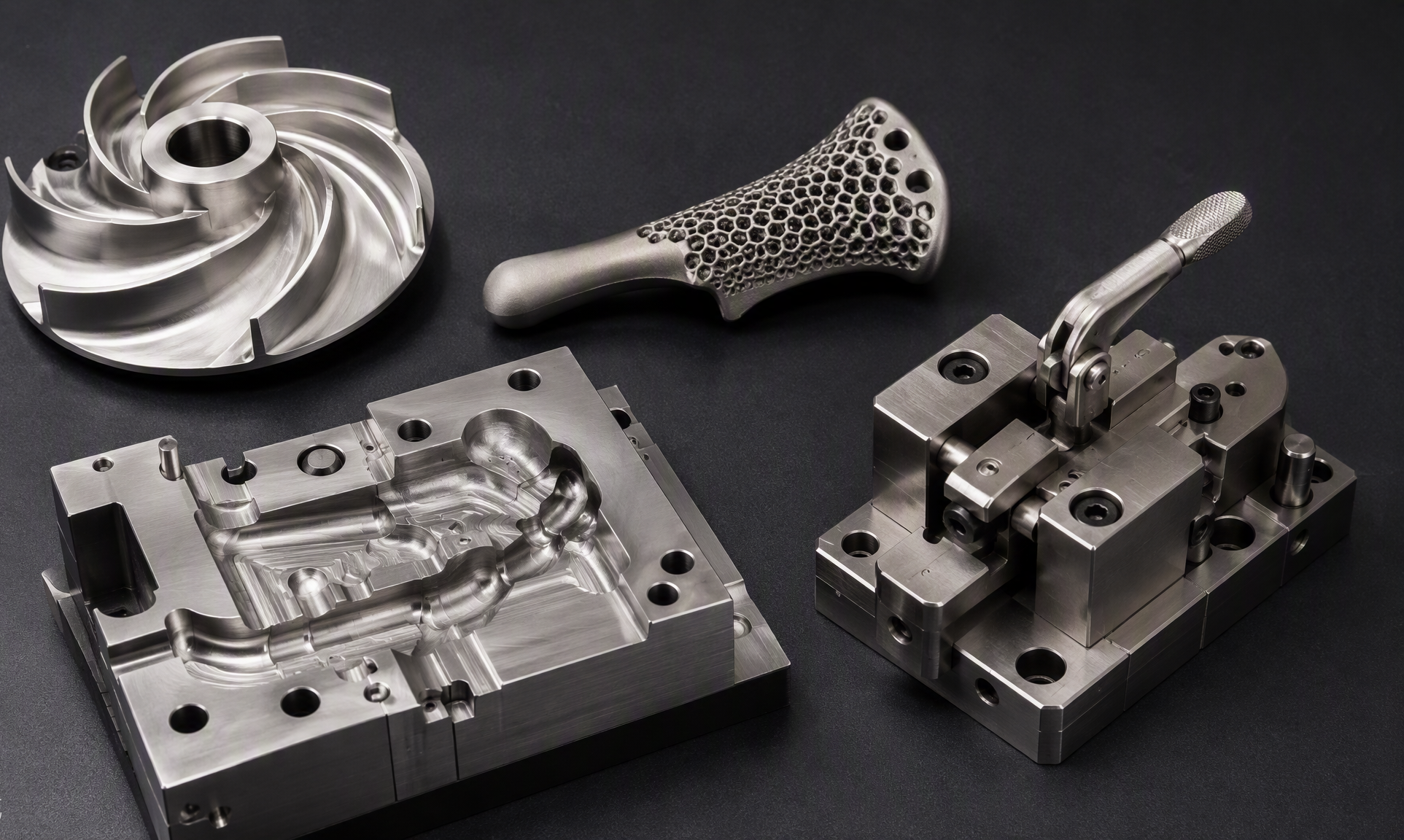
Typical SLM stainless steel parts: pump impeller, orthopedic implant, mold insert and industrial fixture.
5. Post-Processing: Where the Two Routes Really Differ
Both materials share a common post-print backbone, then branch into material-specific routes.
Shared steps for both materials
- Depowdering — removing loose powder from channels and cavities (critical for internal cooling passages).
- Part removal — wire EDM or bandsaw cutting the parts off the build plate.
- Stress relief — annealing to relax residual stress before supports are removed (for 316L, typically around 600 °C).
- Support removal — manual breaking, milling or grinding; steel supports are harder to remove than aluminum ones.
- Surface finishing — blasting, tumbling or CNC machining of mating faces and threads.
Aluminum-specific post-processing
- T6 heat treatment (solution + artificial aging). This is the defining step for AlSi10Mg: solution treatment around 520–540 °C, water quench, then aging around 160 °C. It homogenizes the as-built silicon network and raises strength to ~320 MPa with improved ductility — but note the quench can distort thin walls.
- Anodizing (Type II/III). Adds a hard, corrosion-resistant, dyeable oxide layer — available in colors — making it both a functional and cosmetic finish.
- Bead blasting for a uniform matte look; CNC machining for bearing seats and sealing faces.
316L-specific post-processing
- Passivation — a nitric or citric acid bath that restores the chromium-oxide layer and maximizes corrosion resistance; essential for medical, food and marine parts.
- Electropolishing — electrochemically smooths and brightens the surface, reducing roughness and improving cleanability and fatigue performance.
- HIP (Hot Isostatic Pressing) — more commonly specified for steel than aluminum when fatigue-critical or pressure-bearing parts need internal porosity closed (typically 100+ MPa argon at elevated temperature).
- Machining and grinding — 316L work-hardens, so sharp tooling and rigid setups are required.
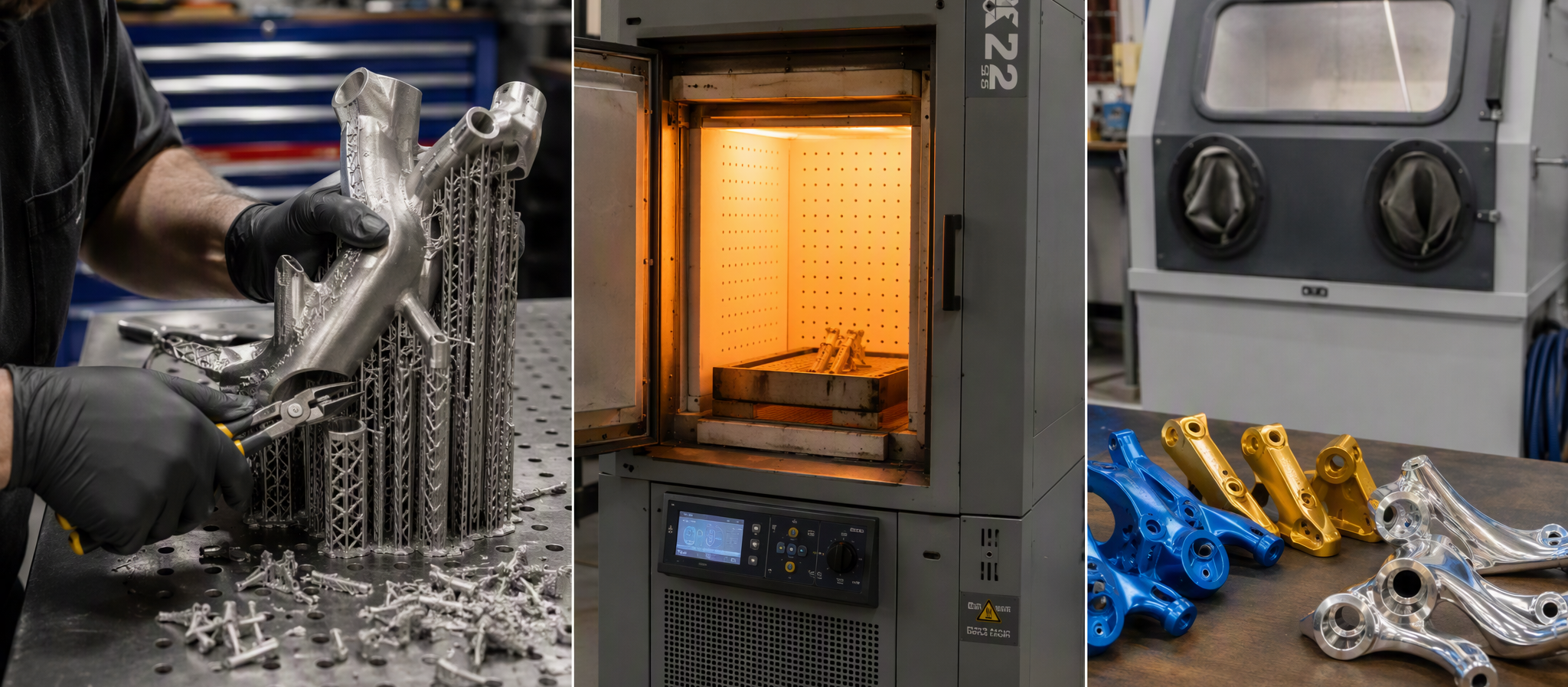
Post-processing routes: support removal, heat treatment, blasting and anodized / electropolished finishes.
6. Application Guide: Which Material for Which Job
Choose aluminum (AlSi10Mg) when you need:
- Minimum weight — aerospace, UAV, motorsport, robotics end-effectors
- Thermal performance — heat sinks, heat exchangers, cold plates, conformal cooling
- Thin-wall, lightweight housings and structural brackets
Choose 316L stainless steel when you need:
- Corrosion resistance — marine hardware, chemical valves, food and pharma equipment
- Biocompatibility — surgical tools, dental and orthopedic implants
- Strength and wear — tooling, fixtures, mold inserts, impellers, structural hardware
- Elevated-temperature service beyond aluminum’s comfort zone
Quick decision checklist
- 1. Is weight the top priority? → Aluminum
- 2. Will the part face salt water, chemicals, or sterilization? → 316L
- 3. Is it a thermal-management part? → Aluminum
- 4. Is it load-bearing, wear-prone tooling? → 316L
- 5. Tight budget and easy printing? → 316L is usually the safer first print
7. Conclusion
Neither material is “better” — they solve different problems. AlSi10Mg is the lightweight, high-conductivity specialist that rewards careful process control with unbeatable strength-to-weight parts. 316L is the robust, corrosion-resistant workhorse with a forgiving process window and a vast application base from operating rooms to ocean floors. The smartest designs often use both — aluminum where grams count, steel where the environment bites.
Need help choosing — or printing? At UtelyMachine (www.utelymachine.com), we run industrial SLM systems for both aluminum alloys and stainless steels, backed by full in-house post-processing: T6 heat treatment, anodizing, passivation, electropolishing, HIP coordination and precision CNC finishing. Send us your STEP file for a free DFM review and a 24-hour quotation — our engineers will tell you honestly which material fits your part best.