


Gold Plating on Plastic: The Complete Process Behind Those Mirror-Bright Golden Lamp Shades
How non-conductive ABS becomes a mirror-bright golden lamp shade: the full plating process, the operating details that matter, and where it wins in the lighting industry.

Gold-plated plastic lighting: mirror-bright pendants and chandeliers with genuine metallic finish on lightweight ABS.
Walk into any lighting showroom and the fixtures that catch your eye first are usually the golden ones — mirror-bright pendants, chandeliers, and reflector trims that look like solid brass. Pick one up, though, and the surprise is the weight: most of them are plastic underneath. Gold-finished plastic electroplating has become the lighting industry’s favorite way to deliver a premium metallic look at a fraction of the cost and weight of metal.
But plastic doesn’t conduct electricity — so how do you electroplate it? This guide walks through the complete gold plating process for plastics, the operating details that separate a flawless finish from a blistered reject, and why the lighting industry depends on it.
Why Plate Plastic at All?
The logic is simple: plastic gives you complex shapes, low weight, and low cost; metal plating gives you luxurious appearance, surface hardness, and corrosion resistance. A gold-plated ABS lamp shade weighs a fraction of a spun-brass one, ships cheaper, never dents in transit, and still reflects light like a mirror. For lighting manufacturers, that’s a decisive combination.
The material of choice is almost always plating-grade ABS (with butadiene content ideally controlled at 18–23%). ABS+PC blends and polycarbonate can also be plated with modified pretreatment, while PP and PE are generally not plateable by conventional chemistry.
The Complete Gold Plating Process, Step by Step
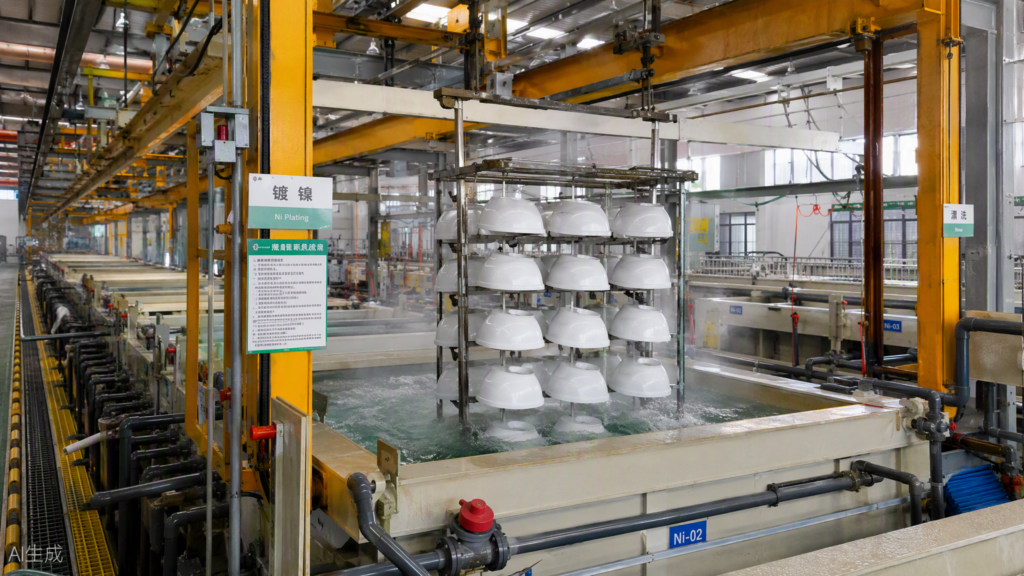
An automatic plating-on-plastics line: racks of ABS lamp shades move through pretreatment, rinsing and plating tanks.
Because plastic is non-conductive, the process runs in three stages: pretreatment → electroless metallization → electroplating. Between every bath, parts are rinsed to prevent chemical carry-over.
Stage 1 — Pretreatment (the make-or-break stage)
- 1. Degreasing: Alkaline cleaning at 50–60 °C removes mold-release agents, oils, and dust from injection molding. Incomplete degreasing is the number-one cause of peeling and blistering later.
- 2. Etching (roughening): Parts are immersed in a chromic acid / sulfuric acid bath (CrO₃ 350–430 g/L, H₂SO₄ 380–400 g/L, 60–70 °C, typically 8–15 minutes). The acid selectively dissolves the butadiene rubber phase in ABS, creating microscopic anchor pores 1–5 μm wide. Under-etch and the plating peels; over-etch and the surface turns dull and weak. This is the most chemically sensitive step of all.
- 3. Neutralization: Residual hexavalent chromium is reduced and rinsed away (typically with dilute hydrochloric acid or sodium bisulfite) so it can’t poison downstream baths.
- 4. Activation: A colloidal palladium-tin solution deposits catalytic palladium “seeds” into the etched micro-pores — the nucleation sites where metal will first grow.
- 5. Acceleration: Excess stannous hydroxide is stripped away, exposing bare palladium, ready to catalyze the next step.
Stage 2 — Electroless Metallization
- 6. Electroless nickel or copper: An autocatalytic chemical bath — no electricity — deposits a thin, perfectly uniform conductive metal film over the entire surface, even inside deep recesses. From this moment on, the plastic part conducts electricity like a metal part.
Stage 3 — Electroplating (building the real coating)
- 7. Acid bright copper: Builds leveling thickness and mirror smoothness (CuSO₄ 200–220 g/L, 25–35 °C).
- 8. Semi-bright nickel + bright nickel: Dual nickel layers provide corrosion resistance, brightness, and the foundation for the top finish. (For chrome looks, decorative chrome follows here instead.)
- 9. Gold plating: The final flash — a thin layer of real gold (or a gold-tone alloy) is electroplated over the bright nickel. Because gold is used only as a microns-thin top layer, cost stays modest while the color and tarnish resistance are genuine.
- 10. Post-treatment: Passivation, optional transparent topcoat (gloss or matte) for wear resistance, and low-temperature drying.
The result: a layered system — ABS → electroless nickel → copper → semi-bright nickel → bright nickel → gold — with total metallic coating typically 20–45 μm.
Operating Know-How: Where Parts Succeed or Fail
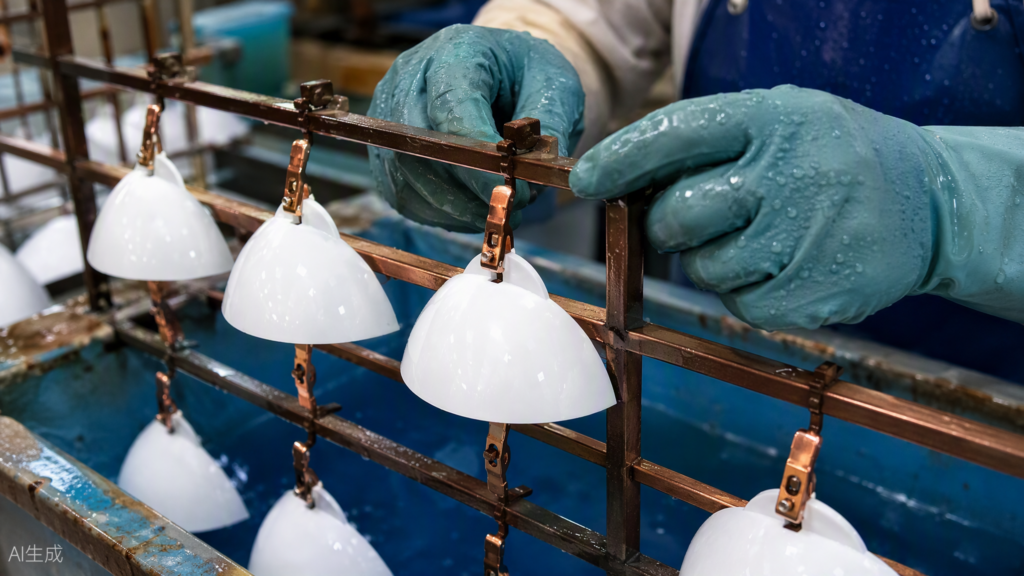
Racking matters: clips grip each shade at hidden hanging points, because every contact leaves an unplated mark.
- Plastics float. Lamp shades are buoyant in the baths, so fixtures must be weighted and parts locked firmly onto the rack.
- Contact points matter. Racking clips grip the shade at designated hanging points — usually inside the rim or at tooling holes — because every contact point leaves an unplated mark. Smart part design puts these marks where nobody will ever see them.
- Dry the resin before molding. ABS pellets must be dried at ~80 °C for 2–4 hours before injection; moisture in the substrate becomes blistering bubbles after plating.
- Deep recesses need auxiliary anodes. A dish-shaped reflector shades its own center; shaped (“pictorial”) anodes ensure current reaches the concave areas evenly.
- Watch bath temperature. Excessive temperature warps thin plastic parts outright.
- Bubbles and black spots usually trace back to poor degreasing, exhausted sensitizer, or contaminated copper anodes — bath maintenance is a daily discipline, not a monthly one.
The Alternative Route: Vacuum Metallizing (PVD) Gold
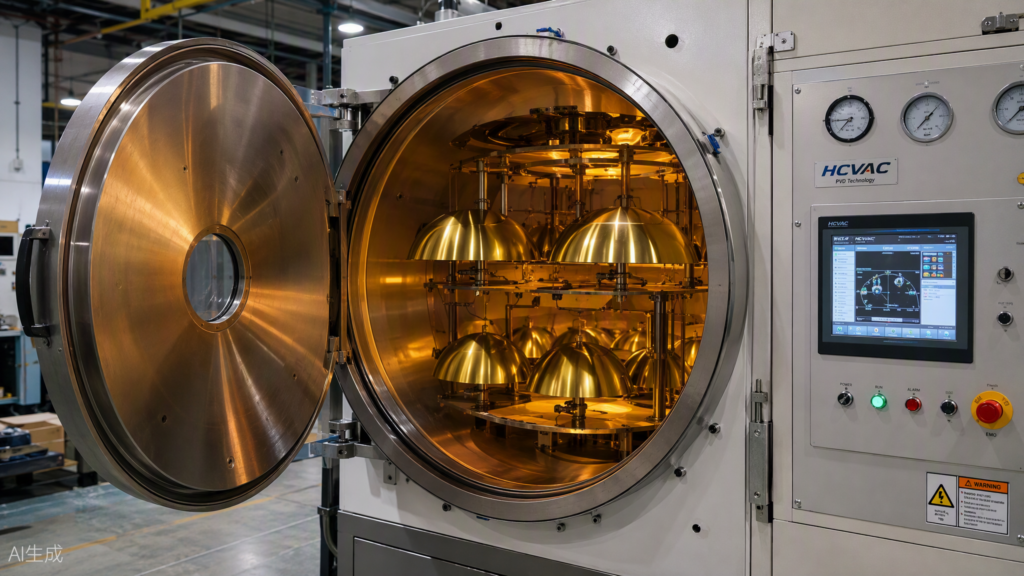
PVD vacuum coating: lamp shades on a rotating fixture receive a titanium-nitride golden finish inside the chamber.
Not every golden lamp part is wet-plated. Vacuum metallizing / PVD offers a dry alternative:
- Process: parts are cleaned, sprayed with a leveling primer, baked, then coated inside a vacuum chamber — aluminum by evaporation for a mirror base, or titanium nitride (TiN) by sputtering for a true gold color — then sealed with a clear topcoat (glossy or matte).
- Advantages: no chromic acid, no wastewater, RoHS-friendly; works on plastics that can’t be chemically etched; handles complex shapes with deep “dead corners” that wet plating can’t reach — one reason classic gold parabolic louver grilles for ceiling luminaires went the vacuum route. Chamber temperatures stay below 80–100 °C, safe for heat-sensitive plastics.
- Trade-offs: thinner coating than electroplating, higher equipment cost, and per-part economics that favor high volumes.
For lighting brands, the choice is pragmatic: wet electroplating for the deepest, most authentic mirror-gold; PVD for intricate geometry and eco-compliant production.
Where It Shows Up in the Lighting Industry
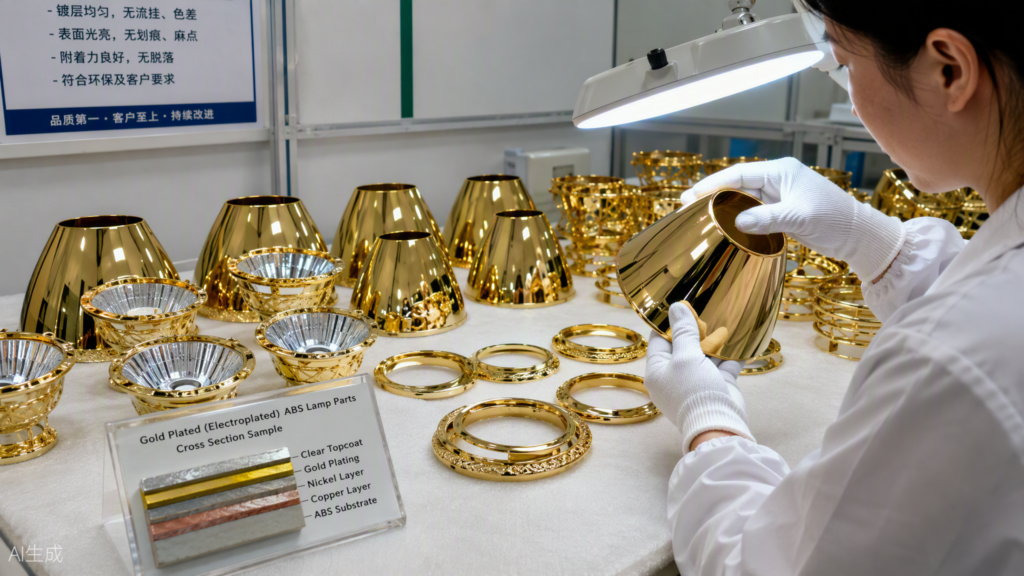
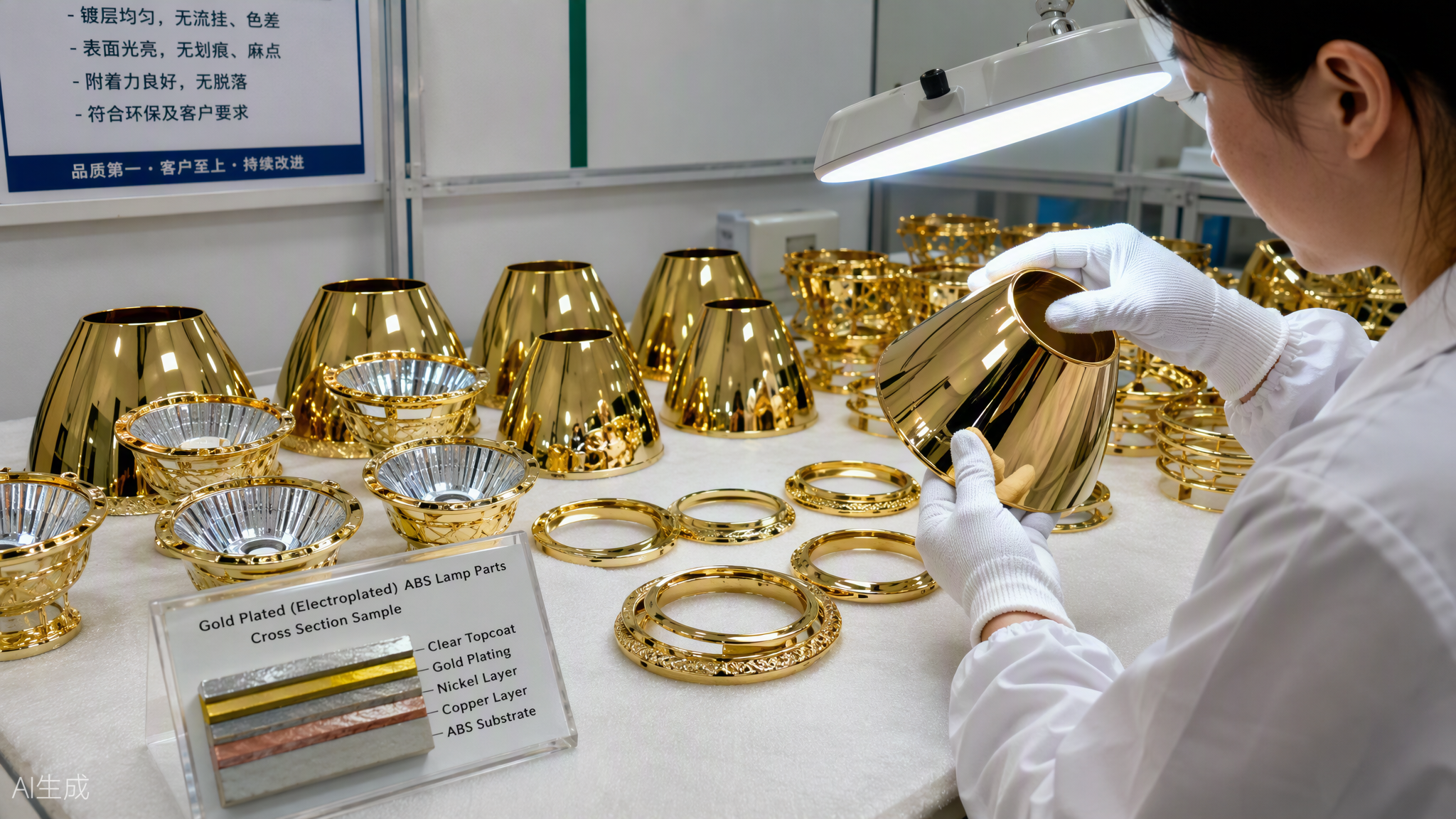
QC inspection of gold-plated ABS lamp parts: reflector cups, trim rings and a cross-section sample showing the coating layers.
- Pendant & chandelier shades: mirror-gold ABS shells replace spun brass at a fraction of the weight — safer overhead, cheaper to ship.
- Reflector cups and parabolic louvers: gold-toned reflectors add warm color temperature character to the beam while the plastic substrate allows precision optical shapes.
- Decorative trim rings and bezels: downlight and spotlight trims get the jewelry finish that sells the fixture.
- Hotel, retail and hospitality projects: the “warm luxury metal” trend in interior lighting is largely delivered by plated plastics, not metal.
Quality checkpoints before shipment typically include coating uniformity and color consistency, cross-cut adhesion testing (no peeling), scratch and flow-mark inspection, and — for demanding buyers — salt spray testing on passivated parts.
Суть дела
Gold plating on plastic is a mature but demanding process: a dozen chemical baths, tight parameter windows, and fixture design that starts at the part-drawing stage. Done right, it turns a two-dollar molded shade into a product that looks like solid brass — which is exactly why the lighting industry runs on it.
Developing a lamp housing, reflector, or decorative trim that needs a gold, chrome, or custom metallic finish? Send us your CAD files (STEP/IGES) and target finish — our team covers the full chain from injection molding through electroplating and PVD coating, with free DFM review for plateability (hanging points, wall thickness, corner radii) and a quotation within 24 hours.
UtelyMachine — from plastic molding to mirror-finish plating, your one-stop partner for lighting components. Visit us at www.utelymachine.com.