


Vacuum Casting vs. CNC Machining Accuracy: How Precise Are Silicone-Mold Parts Compared to Machined Plastic Parts?
One order of magnitude apart on paper — but the real story is where casting variation comes from, and when ±0.1 mm is more than good enough.
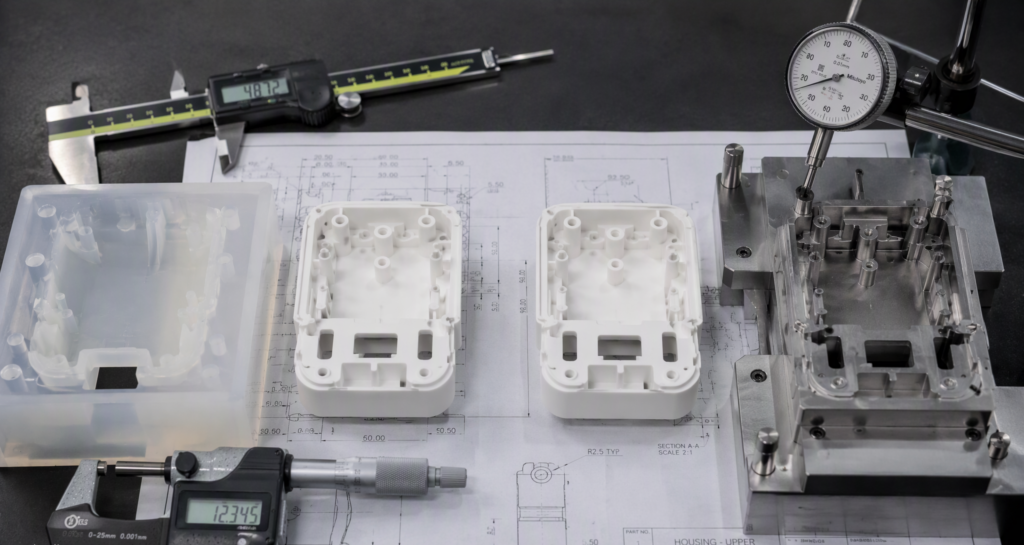
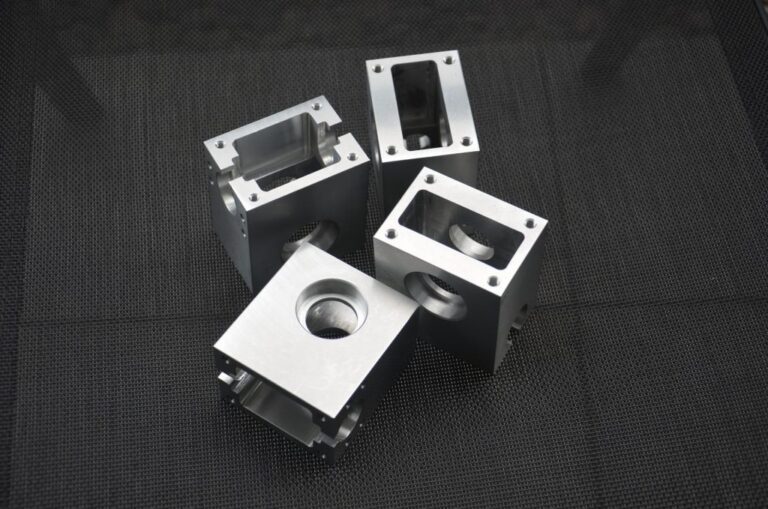
Two identical housings — one cast from a silicone mold, one CNC machined — measured against the same drawing.
When you order plastic prototype parts, two numbers quietly decide whether your assembly clicks together or rattles apart: how accurate the process is, and how repeatable it is.
Vacuum casting (silicone mold replication) and CNC machining are the two most common ways to make low-volume plastic parts — and their precision sits a full order of magnitude apart. A machined plastic part holds ±0.01–0.1 mm; a vacuum-cast part typically holds ±0.1–0.3 mm.
But that headline gap hides the more interesting story: why casting accuracy behaves the way it does, where the variation actually comes from, and when ±0.1 mm is more than good enough. This article puts both processes under the caliper.
1. The Headline Numbers
| Dimension | CNC Machining (plastics) | Vacuum Casting (PU in silicone mold) |
| General tolerance | ±0.05–0.1 mm | ±0.1–0.3 mm (typical rule: ±0.3% of nominal, min ±0.3 mm under 100 mm) |
| Precision features | ±0.01–0.05 mm achievable | ±0.15 mm on small, well-designed parts (best case) |
| Shrinkage | None — cut from solid, stable stock | +0.15% typical (resin cure), up to ~1% for some PU grades |
| Part-to-part repeatability | Excellent — every part individually cut to the same program | Good within a mold; drift appears as the silicone mold ages (part #1 vs. #25 differ slightly) |
| Surface finish | Ra 0.4–3.2 µm as-machined | Replicates the master pattern’s finish (can be near-mirror) |
| Verification | CMM reports against ISO 2768 / GD&T | Dimension reports per batch; standards like ISO 2768-Coarse |
The pattern is clear: CNC machining is the precision champion; vacuum casting is the replication champion. Machining wins on absolute accuracy and repeatability; casting wins on surface fidelity and per-part cost across a batch of 5–25 copies.
2. Why CNC Machining Is So Accurate
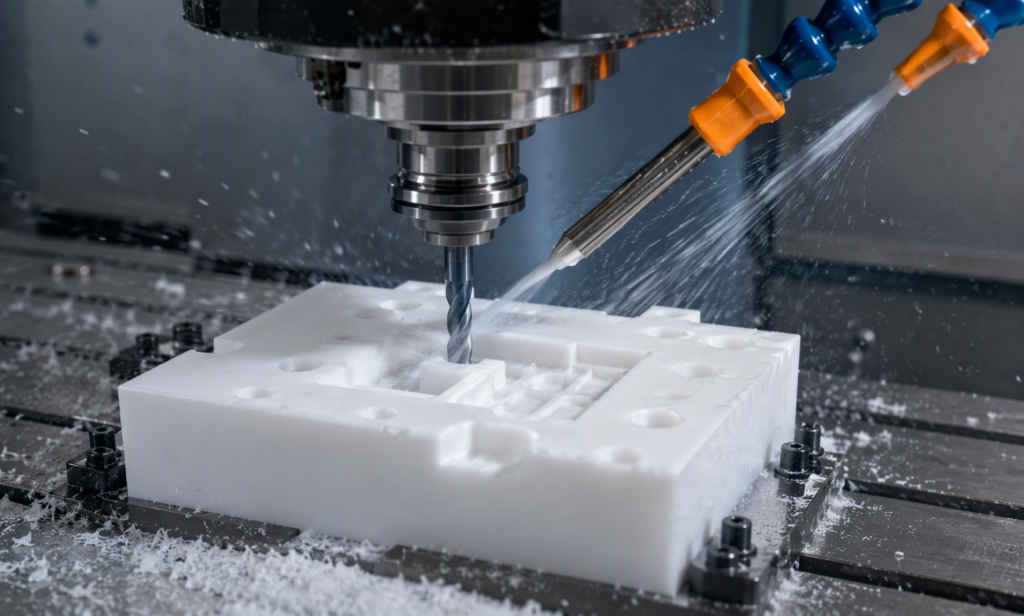
Cutting from solid, stable stock: no melting, no curing — and therefore no shrinkage
CNC machining’s precision comes from its physics: the part is cut from a solid, dimensionally stable block of ABS, POM, PC, nylon, or PEEK. There is no melting, no curing, no phase change — and therefore no shrinkage. The final dimension is whatever the machine’s positioning system produces: general plastic machining at ±0.05–0.1 mm (ISO 2768-m class work), precision plastic machining at ±0.01–0.05 mm with sharp tooling, proper feeds, and temperature control, and metal machining at ±0.005–0.025 mm on the same machines.
What few buyers realize: machining plastics is actually harder than machining metals at the precision end, because plastics are soft (tool pressure deflects thin walls), thermally expansive, and sometimes hygroscopic (nylon swells with moisture). Good shops compensate with sharp single-flute cutters, air or mist cooling, stress-relieved stock, and final passes at low engagement. Done properly, every critical dimension can be CMM-verified against the drawing — ISO 2768 classes, GD&T callouts, and all.
Where machining loses: geometry. Internal closed cavities, deep undercuts, and organic shapes can be physically unreachable by a rotating cutter. And cost scales with part count — every one of 20 parts costs roughly the same machine time.
3. Where Vacuum Casting’s Accuracy Actually Comes From (and Goes)
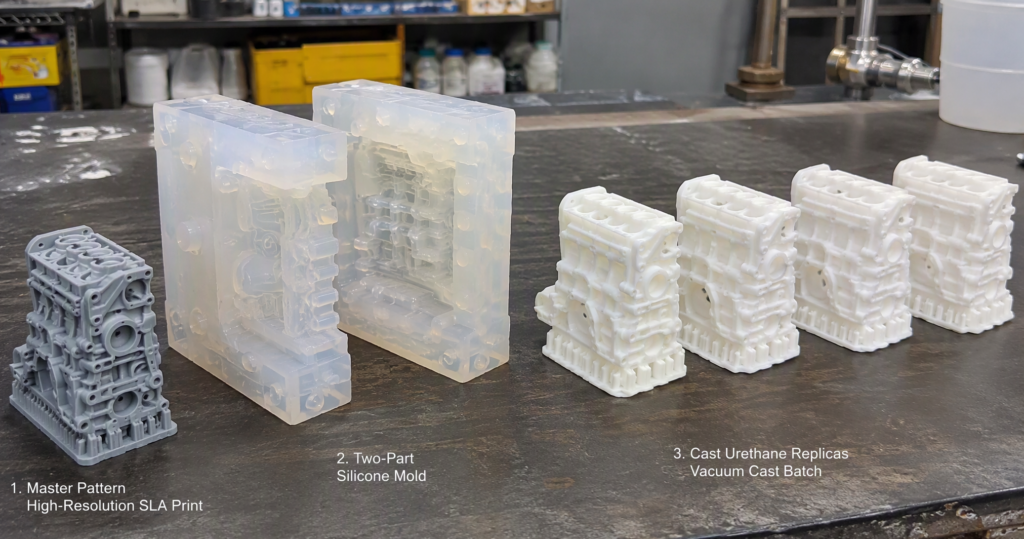
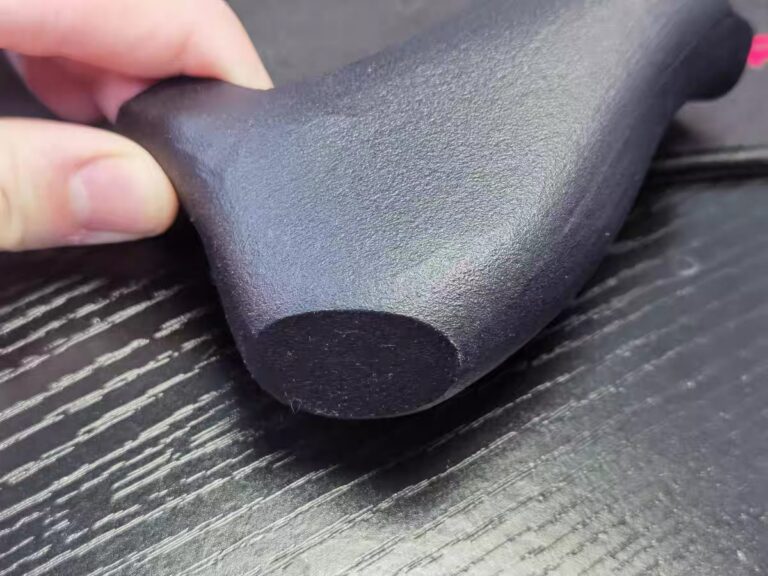
The four-link accuracy chain: master pattern, silicone mold, resin shrinkage, mold aging.
A cast part’s precision is not decided at pouring time. It is the product of a four-link chain, and each link adds its own variation:
- Link 1 — The master pattern. The silicone mold copies the master with near-perfect fidelity, so the master’s accuracy becomes the batch’s ceiling. A high-resolution SLA master (itself accurate to ±0.05–0.1 mm) is the standard; a sloppy master dooms every copy. Rule: the master must be better than the tolerance you need.
- Link 2 — The silicone mold. Silicone cures around the master with minimal shrinkage and excellent detail capture — down to surface texture. But silicone is a soft tool: it flexes slightly under resin pressure and during demolding, unlike a rigid steel cavity.
- Link 3 — Resin cure shrinkage. The biggest source of dimensional variation. Two-part polyurethane shrinks as it polymerizes: +0.15% for quality low-shrink grades, up to ~1% for others. On a 100 mm dimension, 0.15% is 0.15 mm — right at the edge of a ±0.1 mm tolerance band. Experienced shops compensate by scaling the master, controlling cure temperature, and choosing low-shrink resins. Thick-and-thin sections shrink unevenly, which is why irregular geometries can deviate or warp.
- Link 4 — Mold aging. Each casting cycle thermally and mechanically stresses the silicone. Over a mold’s 15–25-shot life, it gradually deforms: part #20 will measure slightly different from part #1. For most applications the drift is small, but for precision fits it must be planned — critical assemblies should come from early shots, or from a fresh mold.
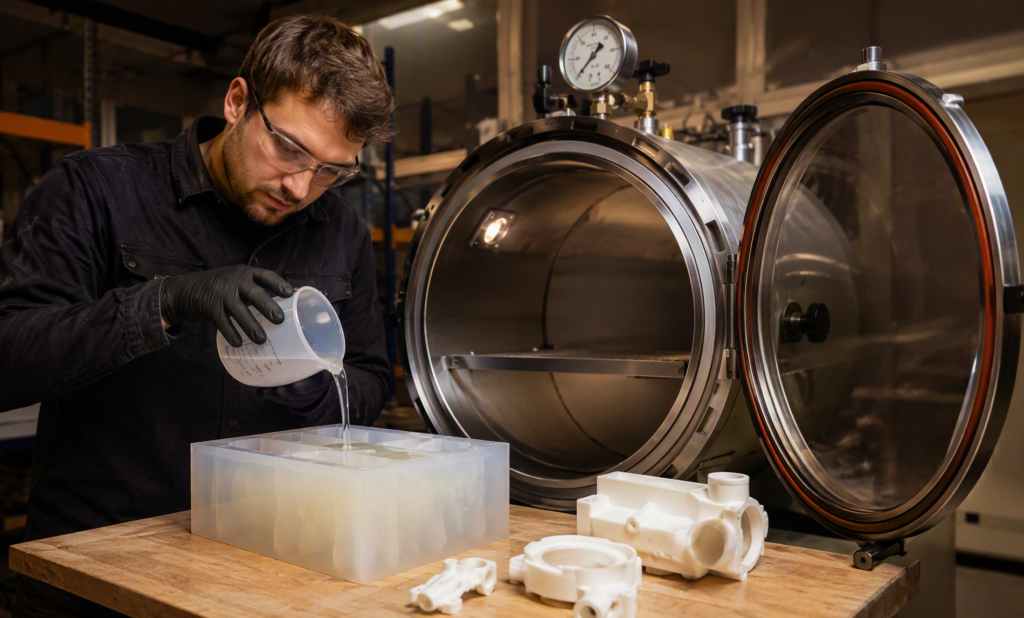
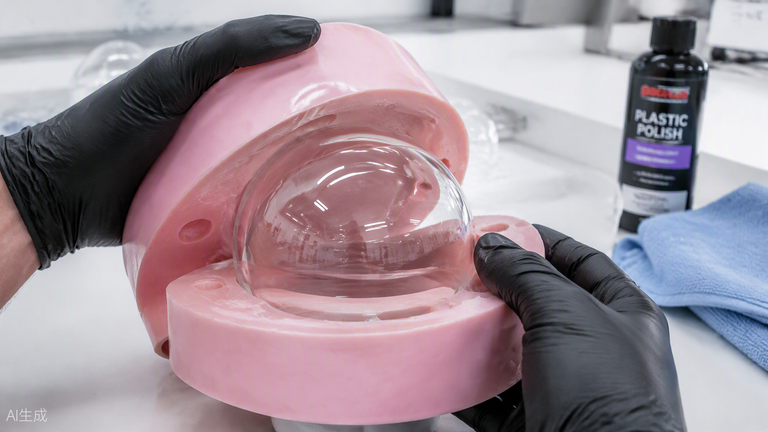
Pouring PU resin under vacuum — every shot adds a little wear to the soft silicone tool.
4. Side-by-Side: What the Difference Means in Practice
| Scenario | Better choice | Why |
| Precision assembly — shafts, bearing seats, snap fits with tight gaps | CNC | ±0.01–0.05 mm features are routine; casting shrinkage can’t guarantee them |
| Functional & environmental testing in real engineering plastic | CNC | Solid stock material (true ABS/POM/PC/PEEK), no cure shrinkage, isotropic strength |
| Appearance models, marketing samples, user-trial units | Vacuum casting | Replicates master’s surface perfectly; PU grades simulate ABS/PP/PC feel |
| 5–25 identical parts for a pilot batch | Vacuum casting | Per-part cost drops after mold amortization; machining 25 pieces costs ~25× the first |
| Complex geometry with undercuts and fine texture | Vacuum casting | Soft silicone releases shapes no cutter can reach |
| Large parts (up to ~1–2 m: bumpers, enclosures) | Vacuum casting | Big CNC setups get expensive; silicone molds scale up cheaply |
| Parts needing certified dimensional reports (GD&T, CMM) | CNC | Every dimension individually verifiable against the drawing |
A realistic accuracy expectation for casting: a well-run vacuum casting job on a small, well-designed part achieves ±0.1–0.15 mm. The general industry rule of thumb: ±0.3 mm, or ±0.3% of nominal dimension, whichever is larger — with sharp corners and fine text slightly rounded, and thick/irregular sections needing individual review.
5. How to Get the Best Accuracy From Each Process
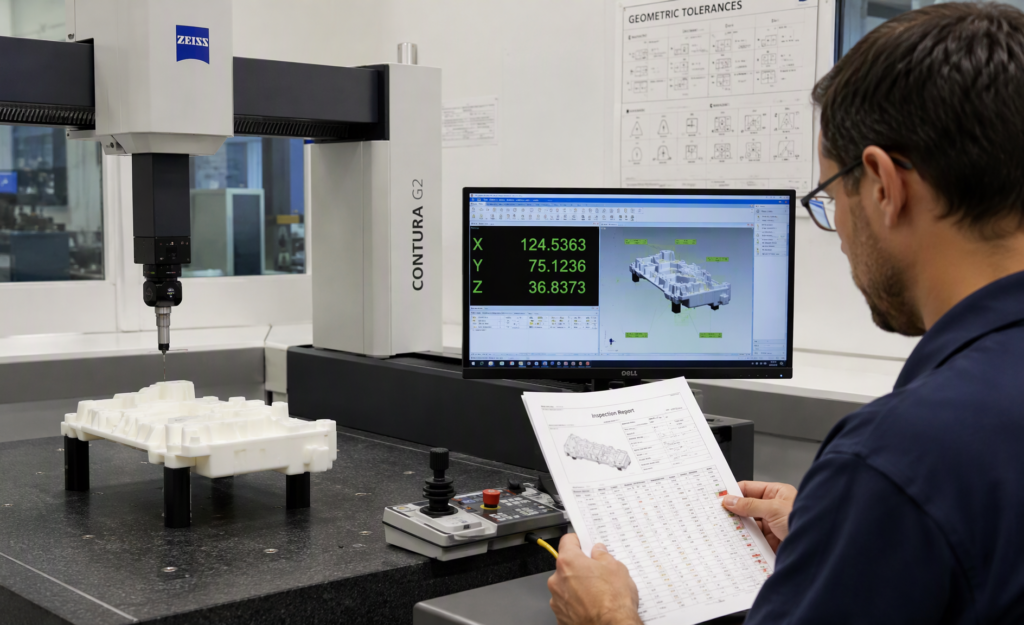
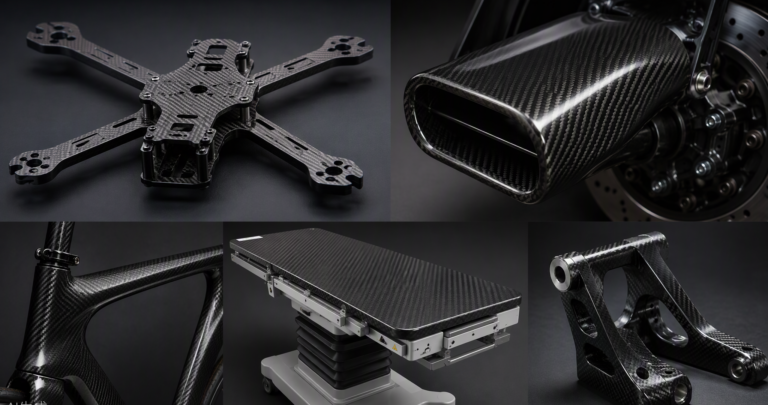
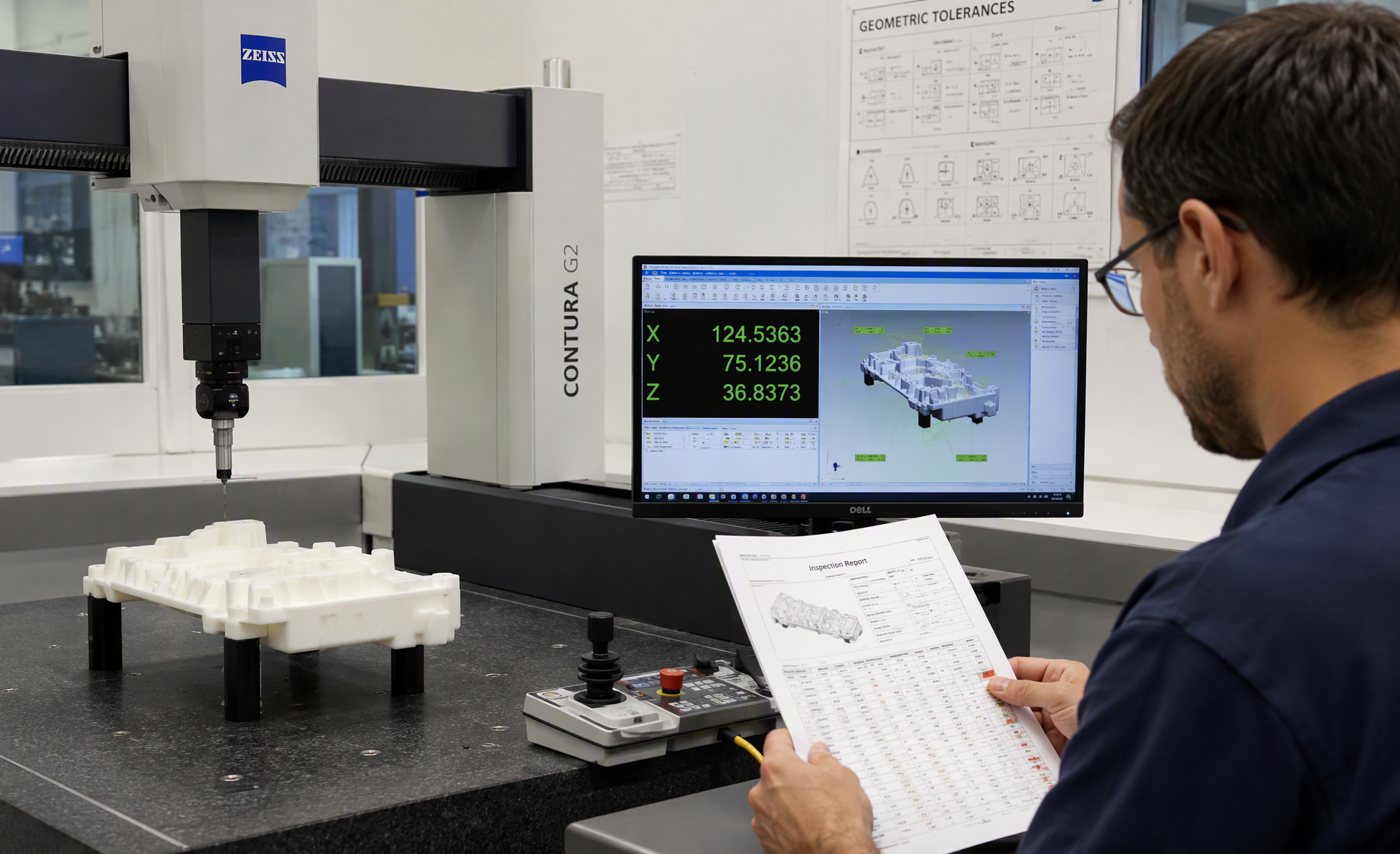
CMM verification: the difference between claimed tolerance and proven tolerance.
For CNC machining:
- Specify tolerances only where function demands them — blanket tight tolerances multiply cost.
- Choose dimensionally stable materials (POM, PC, ABS) over moisture-hungry ones (nylon) for precision parts.
- Ask for CMM inspection reports on critical dimensions.
- Machine critical mating features in a single setup to avoid re-fixturing error.
For vacuum casting:
- Start with a precision master — high-resolution SLA, polished and verified before mold-making.
- Tell your supplier which dimensions are critical — they can scale the master to compensate for the ~0.15% shrinkage and orient the part in the mold to protect key features.
- Keep wall thicknesses uniform to avoid differential shrinkage and warpage.
- Request parts from early mold shots for the tightest assemblies.
- Treat sharp edges and fine text as “slightly rounded” in your design intent.
6. The Verdict
The two processes aren’t rivals — they’re different tools for different questions. “Will it fit and function exactly?” calls for CNC machining: solid stock, no shrinkage, ±0.01–0.05 mm capability, CMM-verified. “Will 20 identical, beautiful copies convince my customer?” calls for vacuum casting: ±0.1–0.3 mm, injection-mold-like surfaces, at a fraction of machining 20 parts. And they combine well: machine the precision inserts and masters, cast the batch around them — overmolding metal or machined inserts is standard casting practice.
7. Get Both Under One Roof
At Utely Machine, we run precision CNC machining (3/4/5-axis, plastics and metals) and vacuum casting side by side — with CMM verification for machined parts and master-pattern compensation for cast batches. Send us your STEP file and tell us which dimensions matter: we’ll recommend the right process, quote within 24 hours, and include a free DFM review. Visit us at www.utelymachine.com.