



Moldeo por inyección Servicios
El moldeo por inyección es un método de moldeo que combina la inyección y el moldeo. Las ventajas del método de moldeo por inyección son que la velocidad de producción es rápida, la eficiencia es alta, la operación se puede automatizar, hay muchas variedades de colores, la forma puede ir de simple a compleja, el tamaño puede ir de grande a pequeño, y el tamaño del producto es preciso, el producto es fácil de reemplazar y se puede formar en piezas de formas complejas; el moldeo por inyección es adecuado para la producción en masa y productos de formas complejas y otros campos de procesamiento de moldeo.
Es ampliamente utilizado para producir piezas de gran volumen. En los productos industriales, los productos moldeados por inyección son: artículos de cocina (cubos de basura, cuencos, cubos, ollas, cubiertos y varios recipientes), las carcasas de equipos eléctricos (secadores de pelo, aspiradoras, licuadoras de alimentos, etc.), juguetes y juegos, diversos productos industriales de automóviles y otras piezas.
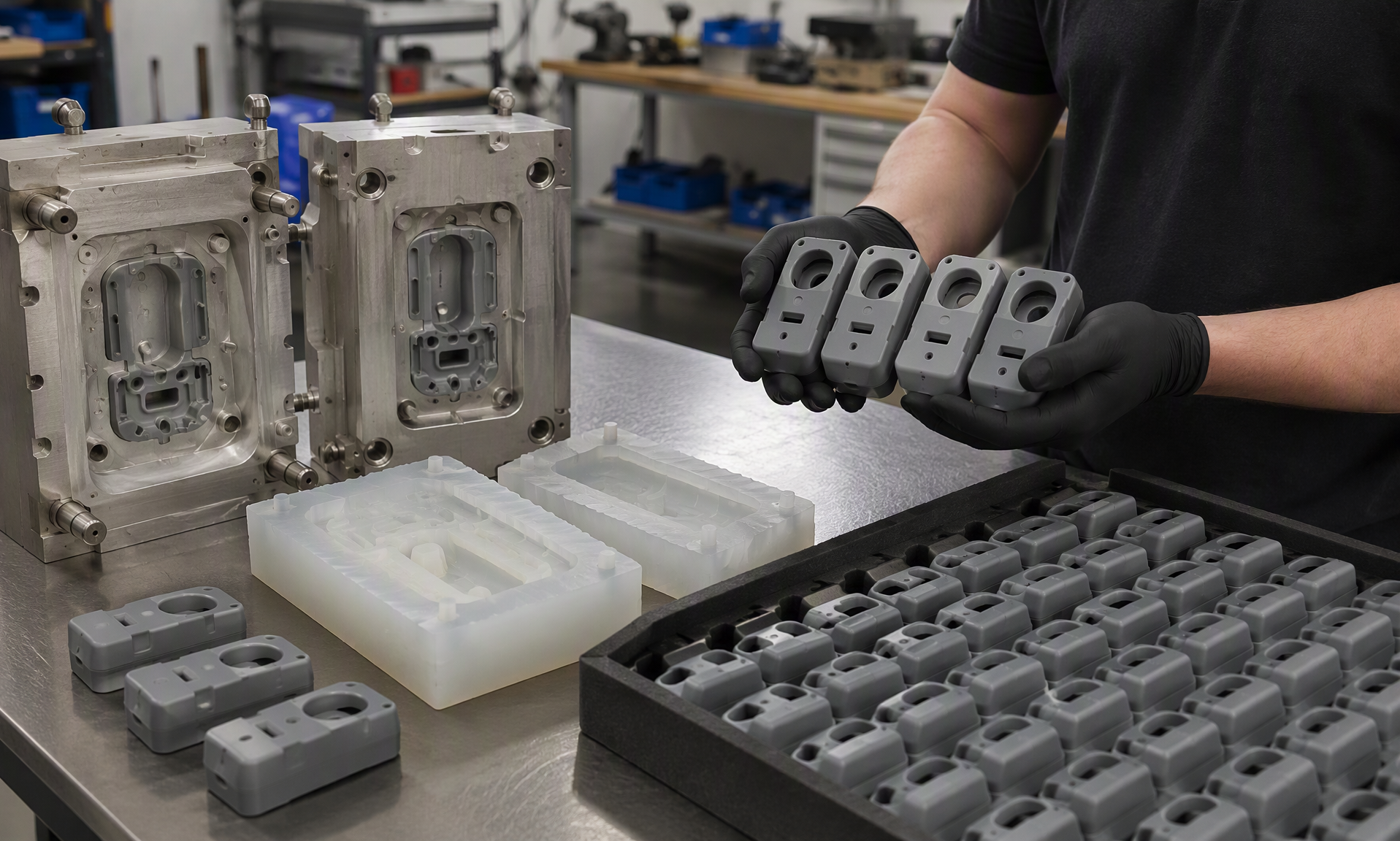
Capacidades de Moldeo por Inyección
|
Servicio |
Detalles |
|
Plazos de entrega |
1-4 semanas |
|
Materiales |
La mayoría de los termoplásticos y algunos metales (como el aluminio y el acero) |
|
Máquinas Disponibles |
Excelente rendimiento y baja tasa de desperdicio |
|
Gama de moldeo por inyección |
Herramentales de inyección de termoplásticos, incluyendo capacidades de insertos y sobremoldeo |
|
Tolerancias de la cavidad del molde |
+/- 0,0127 cm (+/- 0,05 pulgadas) |
|
Vida de moho |
garantizado por al menos 2000 disparos |
¿Por qué elegir nuestros servicios de moldeo por inyección?
Con más de 20 años de experiencia en la fabricación de moldes de plástico, contamos con los equipos de moldeo por inyección más avanzados y confiables del mundo y con operadores experimentados en productos de moldeo de plástico. Podemos ofrecerle servicios integrales como la fabricación rápida de moldes y el moldeo por inyección de gran volumen. Le proporcionamos una gran libertad de diseño y un proceso eficiente de moldeo por inyección de plástico para producir piezas y productos de alta calidad para una productividad óptima y costos de producción reducidos.
Para satisfacer la gran demanda de piezas de plástico de los clientes, actualizamos continuamente nuestros equipos y tecnología y, de esta manera, ofrecemos a los clientes servicios de moldeo por inyección de mayor calidad, que pueden satisfacer todas sus necesidades de prototipos de plástico y producción en masa.

¿Qué es el moldeo por inyección?
El moldeo por inyección es un proceso de fabricación para producir piezas en masa. Se utiliza más comúnmente para producir en masa las mismas piezas y componentes, por lo general a una escala de decenas de miles o incluso millones de veces.
El plástico líquido se introduce a presión en el molde y se curva; suena sencillo, pero es un proceso complejo. Los líquidos utilizados van desde el vidrio caliente hasta diversos plásticos (termoestables y termoplásticos).
Debido a que el uso de un molde de inyección de múltiples cavidades es capaz de producir múltiples piezas por ciclo, el moldeado por inyección es ideal para producir grandes cantidades de piezas de plástico.
Las ventajas del moldeo por inyección son la gran precisión de tolerancia, la repetibilidad, una amplia selección de materiales de procesamiento, bajos costes de mano de labor, una pérdida mínima por desperdicio y un escaso postprocesamiento como el pulido después del moldeo.
Algunas de las desventajas de este proceso son la costosa inversión inicial en utillaje y las limitaciones del proceso.

¿Por qué elegir el moldeo por inyección?
La principal ventaja del moldeo por inyección es la capacidad de escalar la producción de forma centralizada. Una vez que las máquinas y los moldes están listos, el precio por unidad del producto durante la producción es muy bajo. Los precios también bajan drásticamente a medida que se producen más piezas. Otras ventajas incluyen:

- En comparación con los procesos de fabricación tradicionales, como el mecanizado, el moldeo por inyección produce una baja tasa de desperdicio y puede reducir la mayor parte del porcentaje de la pieza en bruto o lámina original. Pero el moldeo por inyección puede tener tasas de desperdicio ligeramente superiores a las de los procesos de fabricación aditiva, como 3D impresión.
- El moldeo por inyección generalmente utiliza materiales termoplásticos reciclables. Los recortes descartados y otras materias primas de desecho se pueden reciclar y añadir a las nuevas materias primas en proporción. (Algunas propiedades de rendimiento de los plásticos se degradan una y otra vez). Estos materiales reciclados son perfectamente adecuados para piezas de baja calidad que no requieren características de alto rendimiento.
- El moldeo por inyección es un proceso altamente repetible. Es decir, todo el proceso de producción puede replicarse. Esta forma de trabajar permite un buen control sobre la consistencia del producto y la fiabilidad de las piezas en la producción en masa de piezas.
Ventajas del moldeo por inyección

Buena precisión dimensional
Excelente acabado superficial
Se puede producir en masa
Casi no se requiere postprocesamiento, como el pulido, después de que se forma la pieza.
Producción automatizada para reducir sus costos
Producción rápida
Los ingenieros profesionales supervisan todo el proceso de fabricación y la tasa de chatarra es baja
Se puede moldear en piezas de formas complejas, adecuado para la producción en masa y productos de formas complejas y otros campos de procesamiento de conformado.
Material para moldeo por inyeccións
Podemos completar el moldeo por inyección de casi cualquier termoplástico.

- El plástico ABS es un terpolímero de tres monómeros: acrilonitrilo (A), butadieno (B) y estireno (S). El contenido relativo de los tres monómeros se puede cambiar arbitrariamente para fabricar diversas resinas.
- El ABS tiene las propiedades comunes de tres componentes: el A lo hace resistente a la corrosión química, al calor y le otorga cierta dureza superficial; el B le confiere alta elasticidad y tenacidad; y el S hace que tenga las características de procesamiento y moldeo de los termoplásticos y mejora las propiedades eléctricas.
- Por lo tanto, el plástico ABS es un tipo de material “resistente, duro y rígido” con materias primas fácilmente disponibles, buen rendimiento integral, bajo precio y amplia aplicación. Una amplia gama de aplicaciones.

- El PC (policarbonato) es también un material plástico comúnmente utilizado en la fabricación de productos
- El policarbonato es resistente a los arañazos y se puede mezclar con otros plásticos para formar materiales más resistentes.
- Además, el PC también se puede mezclar con la hormona sintética BPA, una hormona disruptora endocrina, para aumentar la dureza del PC y evitar que se rompa o se fisure con un uso intenso, como en el caso del biberón de un niño.
- El PC es muy resistente, tiene una transparencia perfecta, dureza ajustable, resistencia a altas temperaturas y es reciclable. El plástico PC se puede moldear mediante moldeo por inyección, moldeo por extrusión, moldeo por soplado, termoconformado y más.

- El nailon tiene una amplia gama de usos. Es un buen material para que los plásticos sustituyan a metales como el acero, el hierro y el cobre. Es un plástico de ingeniería importante. El nailon fundido sustituye ampliamente a las piezas resistentes al desgaste de los equipos mecánicos y reemplaza al cobre y a las aleaciones como piezas resistentes al desgaste de los equipos.
- El nailon es adecuado para fabricar piezas resistentes al desgaste, piezas estructurales de transmisión, piezas de electrodomésticos, piezas de fabricación de automóviles, piezas mecánicas de protección de tornillos, piezas de maquinaria química y equipos químicos. Como turbinas, engranajes, rodamientos, impulsores, manivelas, paneles de instrumentos, ejes de transmisión, válvulas, álabes, varillas roscadas, arandelas de alta presión, tornillos, tuercas, juntas, lanzaderas, manguitos, conectores de casquillos, etc.

- El plástico de ingeniería PBT es un poliéster termoplástico. En comparación con otros plásticos de ingeniería termoplásticos, el PBT no reforzado tiene mejores propiedades de procesamiento y propiedades eléctricas.
- Los principales campos de aplicación del PEEK: el mercado del sector del transporte, como el de la automoción (incluida la aviación), representa aproximadamente el 50% del consumo de resina de PEEK; los equipos de fabricación de semiconductores, el 20%; las piezas mecánicas generales, como las placas de válvulas de compresores, el 20%; los equipos médicos, los instrumentos de análisis y otros mercados representaron el 10%.

- El PEI también se conoce como poli(etilenimina). Un polímero de alto peso molecular soluble en agua. Líquido viscoso incoloro o amarillo pálido, higroscópico, soluble en agua, etanol, e insoluble en benceno.

- Además de los materiales de moldeo por inyección comunes, Utely también ofrece más materiales de moldeo por inyección, incluidos POM, PMMA, etc. Para obtener más información, póngase en contacto con nosotros.
Aplicaciones de moldeo por inyección
El molde de inyección es un equipo de proceso importante para la producción de diversos productos industriales. Con el rápido desarrollo de la industria del plástico y la promoción y aplicación de productos de plástico en la aviación, la industria aeroespacial, la electrónica, la maquinaria, los barcos, los automóviles y otros sectores industriales, los requisitos de los productos sobre los moldes también están aumentando. Cuanto mayor es la edad, más incapaces se han vuelto los métodos tradicionales de diseño de moldes para cumplir con los requisitos actuales. En comparación con el diseño de moldes tradicional, la tecnología de ingeniería asistida por computadora (CAE) puede mejorar la productividad, garantizar la calidad del producto o reducir los costos y la intensidad laboral. Por otro lado, tienen grandes ventajas.

Aviación

Productos electrónicos

Mecánico

Barcos

Coche
Superficie de moldeo por inyección Termina
- Acabado estándar
- Opciones de tratamiento superficial para fabricantes de moldes.
- Tal como fue moldeado
- Sin pulido secundario ni esmerilado. La pieza mostrará marcas de mecanizado.
- Grabado láser
- Grabe números de pieza, logotipos y más en sus piezas.
Preguntas frecuentes sobre moldeo por inyección
Cómo obtener un presupuesto de moldeo por inyección en línea
Cuando solicita una cotización de moldeo por inyección, no solo recibe precios precisos en poco tiempo y nuestro análisis de fabricación. Nuestra plataforma de cotización en línea también le proporciona diseños de puntos de inyección y expulsores, y una herramienta de curva de precios para ayudarle a elegir la mejor opción de herramental para su proyecto.

Cargue sus archivos 2D/3D

Elija el proceso

Pida sus piezas en línea

Reciba sus piezas