




Injection Molding Services
Injection molding is a molding method that combines injection and molding. The advantages of the injection molding method are that the production speed is fast, the efficiency is high, the operation can be automated, there are many varieties of colors, the shape can be from simple to complex, the size can be from large to small, and the size of the product is accurate, the product is easy to replace, and it can be formed into complex shapes. Parts, injection molding is suitable for mass production and complex shape products and other molding processing fields.
It is widely used to produce parts of large volume. In industrial products, the injection molded products are: kitchen supplies (garbage cans, bowls, buckets, pots, cutlery and various containers), the electrical equipment shells (hair dryer, vacuum cleaners, food blenders, etc.), toys and games, various industrial products of cars, and other part.
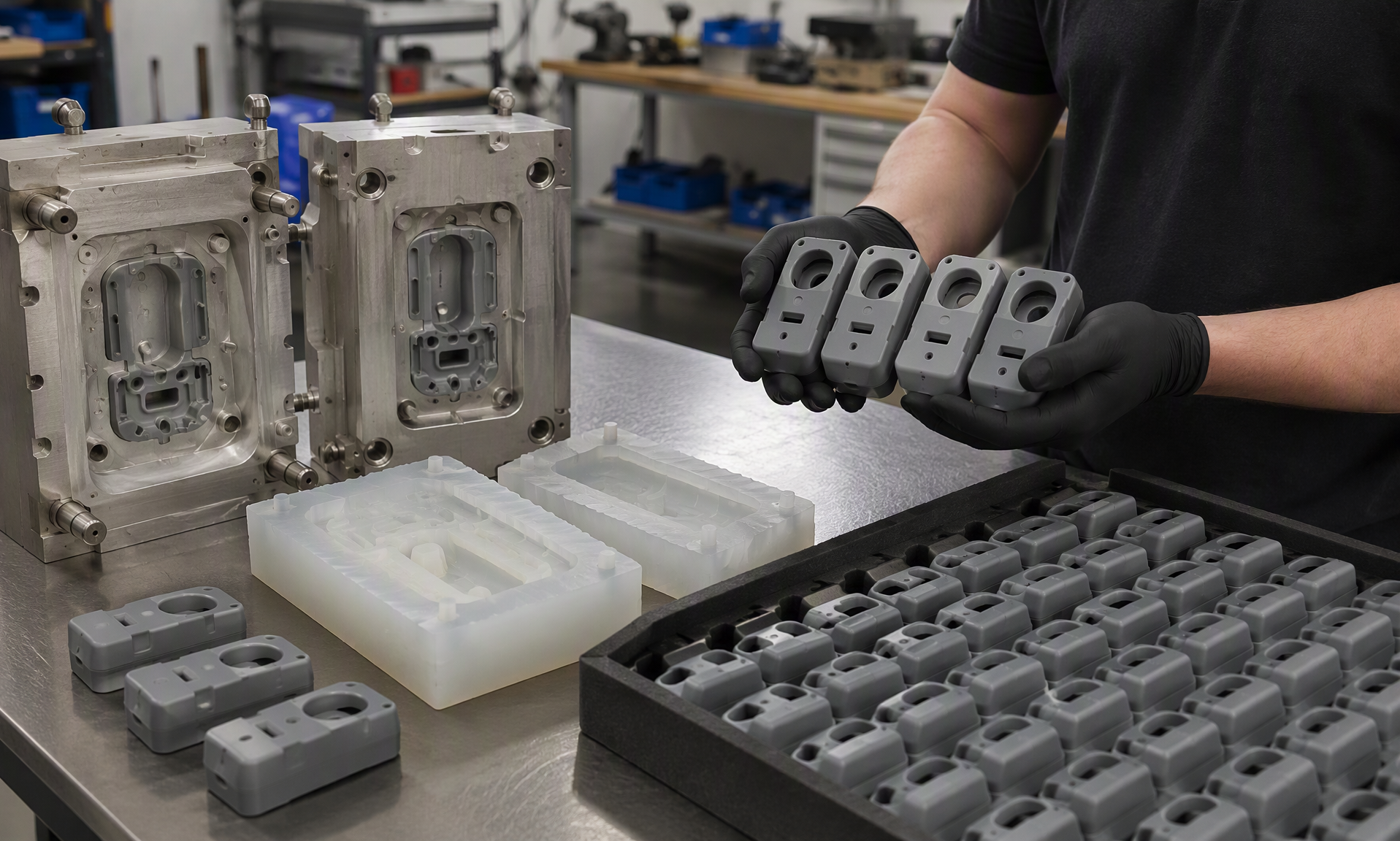
Injection Molding Capabilities
|
Service |
Details |
|
Lead Time |
1-4 weeks |
|
Materials |
Most thermoplastics and some metals (such as aluminum and steel) |
|
Machines Available |
Excellent performance and low scrap rate |
|
Injection molding range |
Thermoplastic injection tooling including insert and overmolding capabilities |
|
Mold Cavity Tolerances |
+/- 0.0127cm ( +/- 0.05 inches) |
|
Mold Life |
guaranteed for at least 2,000 shots |
Why Choose Our Injection Molding Services?
With more than 20 years of experience in plastic mold manufacturing, we have the world’s most advanced and reliable injection molding equipment and experienced operators for plastic molding products. We can provide you with all-round services such as rapid mold manufacturing and high-volume injection molding. We provide you high design freedom and efficient plastic injection moulding process to produce high quality parts and products for optimum productivity and reduced production costs.
To meet the large demand of customers for plastic parts, we continuously upgrade our equipment and technology, and in this way provide customers with more high-quality injection molding services, which can meet all your needs for plastic prototypes and mass production.

What is Injection Molding?
Injection molding is a manufacturing process for mass-producing parts. It is most commonly used to mass-produce the same parts and components, usually on a scale of tens of thousands or even millions of times.
Liquid plastic is forced into the mold and cured – sounds simple, but a complex process. The liquids used range from hot glass to various plastics – thermosets and thermoplastics.
Because using a multi-cavity injection mold is capable of producing multiple parts per cycle, injection molding is ideal for producing large numbers of plastic parts.
The advantages of injection molding are high tolerance accuracy, repeatability, a wide choice of processing materials, low labor costs, minimal waste loss, and little post-processing such as polishing after molding.
Some of the disadvantages of this process are expensive up-front tooling investment and process limitations.

Why Choose Injection Molding?
The main advantage of injection molding is the ability to centrally scale up production. Once the machines and molds are ready, the price per unit of the product during production is very low. Prices also drop sharply as more parts are produced. Other advantages include:

- Compared to traditional manufacturing processes such as machining, injection molding produces a low scrap rate and can reduce the majority of the original billet or sheet percentage. But injection molding may have slightly higher scrap rates for additive manufacturing processes such as 3D printing.
- Injection molding generally uses recyclable thermoplastic materials. Discarded scraps and other waste raw materials can be recycled and added to new raw materials in proportion. (Some performance properties of plastics degrade over and over again). These recycled materials are perfectly fine for low-quality parts that don’t require high-performance features.
- Injection molding is a highly repeatable process. That is, the entire process of production can be replicated. This way of working allows for good control over product consistency and part reliability in the mass production of parts.
Advantages of Injection Molding

Good dimensional accuracy
Excellent surface finish
Can be mass-produced
Almost no post-processing such as polishing is required after the part is formed
Automated production to save your costs
Fast production
Professional engineers supervise the whole manufacturing process, and the scrap rate is low
It can be formed into complex-shaped parts, suitable for mass production and complex-shaped products and other forming processing fields.
Injection Molding Materials
We can complete injection molding of almost any thermoplastic.

- ABS plastic is a terpolymer of three monomers, acrylonitrile (A), butadiene (B), and styrene (S). The relative content of the three monomers can be arbitrarily changed to make various resins.
- ABS has the common properties of three components, A makes it resistant to chemical corrosion, heat resistance, and has a certain surface hardness, B makes it have high elasticity and toughness, and S makes it have the processing and molding characteristics of thermoplastics and improve electrical properties.
- Therefore, ABS plastic is a kind of “tough, hard, and rigid” material with easily available raw materials, good comprehensive performance, low price, and wide application. a wide range of applications.

- PC (polycarbonate) is also a plastic material commonly used in the manufacture of products
- PC is scratch-resistant, and it can be mixed with other plastics to form tougher materials.
- In addition, PC can also be mixed with the synthetic hormone BPA, a hormone-interfering hormone, to increase the PC’s hardness and prevent it from cracking or cracking with heavy use, such as a child’s feeding bottle.
- PC is very strong, has perfect transparency, adjustable hardness, high-temperature resistance, recyclable. PC plastic can be molded by injection molding, extrusion molding, blow molding, thermoforming, and more.

- Nylon has a wide range of uses. It is a good material for plastics to replace metals such as steel, iron, and copper. It is an important engineering plastic. Cast nylon widely replaces wear-resistant parts of mechanical equipment and replaces copper and alloys as wear-resistant parts of equipment.
- Nylon is suitable for making wear-resistant parts, transmission structural parts, household electrical appliances parts, automobile manufacturing parts, screw protection mechanical parts, chemical machinery parts, chemical equipment. Such as turbines, gears, bearings, impellers, cranks, instrument panels, drive shafts, valves, blades, screw rods, high-pressure washers, screws, nuts, seals, shuttles, sleeves, bushing connectors, etc.

- PBT engineering plastic is a thermoplastic polyester. Compared with other thermoplastic engineering plastics, non-reinforced PBT has better processing properties and electrical properties.
- The main application fields of PEEK: the transportation industry market such as automobiles (including aviation) accounts for about 50% of the consumption of PEEK resin, semiconductor manufacturing equipment accounts for 20%, general mechanical parts such as compressor valve plates account for 20%, medical equipment, and analysis Instruments and other markets accounted for 10%.

- PEI is also known as poly(ethyleneimine). A water-soluble high molecular polymer. Colorless or pale yellow viscous liquid, hygroscopic, soluble in water, ethanol, insoluble in benzene.

- In addition to common injection molding materials, Utely also provides more injection molding materials, including POM, PMMA, etc. For more information, please contact us for more information.
Injection Molding Applications
Injection mold is important to process equipment for the production of various industrial products. With the rapid development of the plastic industry and the promotion and application of plastic products in aviation, aerospace, electronics, machinery, ships, automobiles, and other industrial sectors, the requirements of products on molds are also increasing. The higher the age, the more traditional mold design methods have been unable to meet today’s requirements. Compared with traditional mold design, computer-aided engineering (CAE) technology can improve productivity, ensure product quality, or reduce costs and labor intensity. On the other hand, they have great advantages.

Aviation

Electronic Products

Mechanical

Ships

Car
Injection Molding Surface Finishes
- Standard Finish
- Surface treatment options for mold makers.
- As Molded
- No secondary polishing or grinding. The part will show tooling marks.
- Laser Engraving
- Engrave part numbers, logos, and more onto your parts.
Injection Molding FAQs
How to Get An Online Injection Molding Quote?
When you request an injection molding quote, you not only receive accurate pricing in a short period of time. and receive our manufacturing analysis. Our online quotation platform also provides you with gate and ejector pin layouts and a price curve tool to help you choose the best tool option for your project.

Upload your 2D/3D files

Choose the process

Order your parts online

Receive your parts