

Nylon 3D Printing Decoded: Materials, Processes, Applications and The Mistakes That Cost You
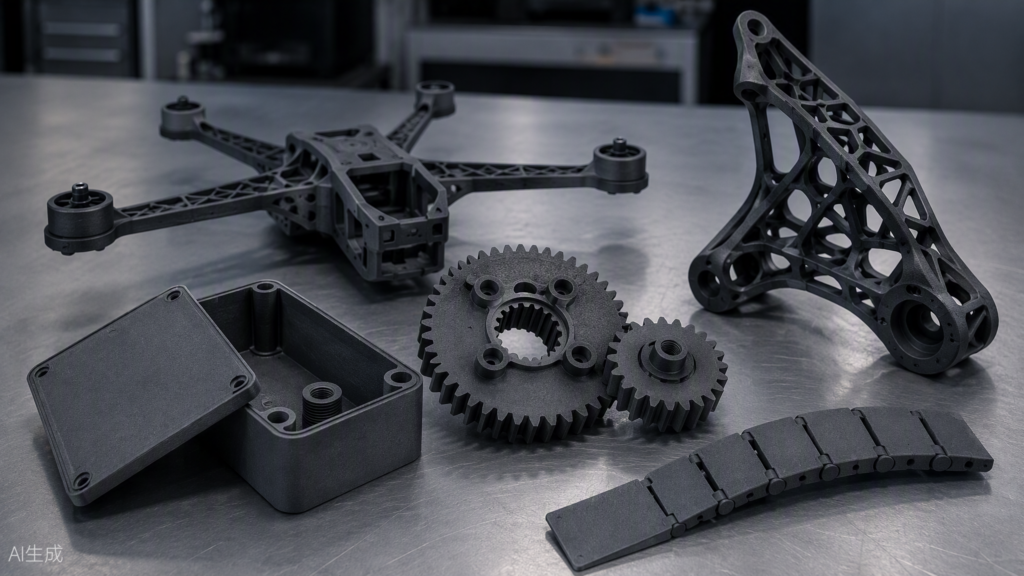
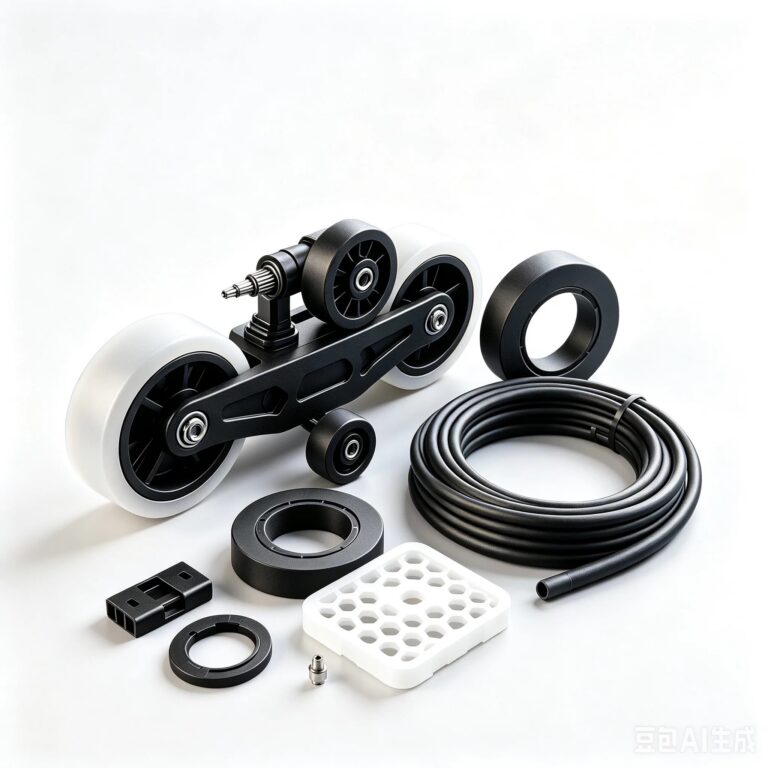
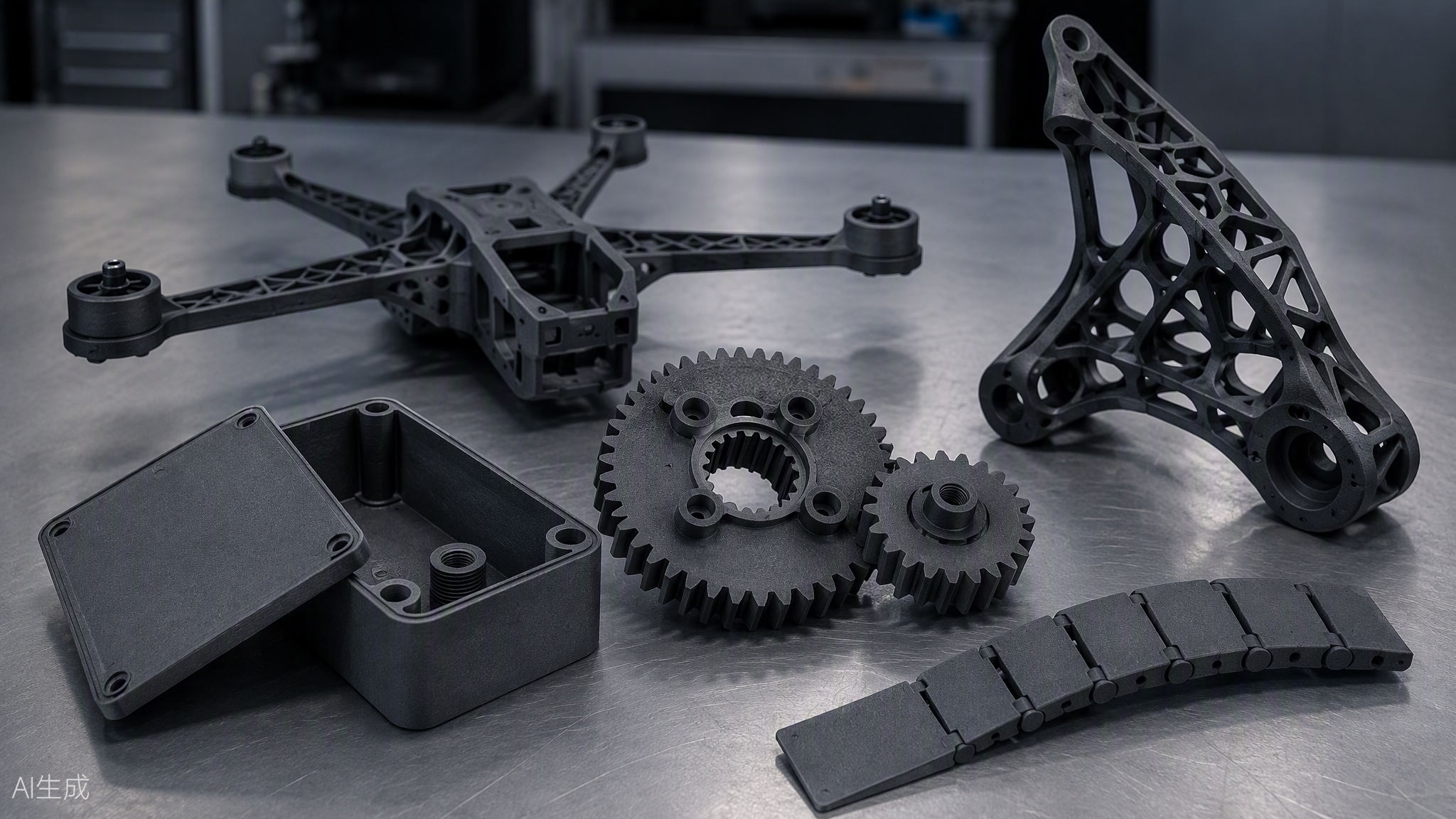
Nylon PA12 parts: gears, a drone frame, snap-fit housing, living hinge and a lattice bracket.
Ask any prototyping bureau which polymer carries their production floor, and the answer is almost always the same: nylon. Nearly ninety years after Wallace Carothers synthesized nylon 6.6 at DuPont in 1935, polyamides have become the default engineering material of powder-bed and filament 3D printing alike — strong yet flexible, abrasion-resistant, chemically tough, and happy to be dyed, painted, or machined after printing.
But “just print it in nylon” hides a lot of decisions. PA6, PA11 or PA12? Filament or powder? SLS or Multi Jet Fusion? And why do so many first attempts end in warped, stringy, moisture-ruined parts? This guide breaks the topic into the four questions that actually matter.
1. Materials: PA6 vs PA11 vs PA12
Nylon grades are named for the carbon atoms in their molecular chain, and small differences in chemistry translate into big differences on the build plate.
PA6 is the classic filament nylon for FDM/FFF printing. Mechanically it sits close to ABS but with far better impact and abrasion resistance — a genuine alternative to polycarbonate that is easier to print. Typical filament pricing runs $20–40 per 500 g spool, with carbon- or glass-fiber reinforced variants climbing to $60–150.
PA12 is the dominant powder grade for SLS and MJF, and for good reason: high rigidity and tensile strength (~48–50 MPa in MJF), excellent dimensional stability, low moisture absorption, and a lower melting point (~175–180 °C) that makes it easier and cheaper to process. It takes post-processing — dyeing, painting, tumbling — beautifully. This is the default choice for production-grade parts.
PA11 differs by a single carbon atom but comes from an entirely different source: castor oil, a renewable bio-based feedstock (Arkema’s Rilsan PA11 has been in production since the 1950s). It trades a little rigidity for noticeably higher ductility, impact resistance, and UV/thermal stability — the better pick for snap fits, living hinges, and parts that flex repeatedly. The trade-offs: it absorbs more moisture than PA12, melts hotter (~200 °C), and prefers an inert build atmosphere to avoid oxidation.
Filled and specialty grades round out the toolbox: 30% carbon-fiber PA12 pushes tensile strength toward ~88 MPa for ultra-stiff drone frames; glass-filled variants reach heat-deflection temperatures above 180 °C for under-the-hood automotive work; flame-retardant UL94 V-0 nylons serve EV and electronics housings; and USP Class VI biocompatible PA12 shows up in surgical guides. Expect powder pricing in the $50–100/kg range depending on composition.
2. Processes: FDM, SLS, and MJF
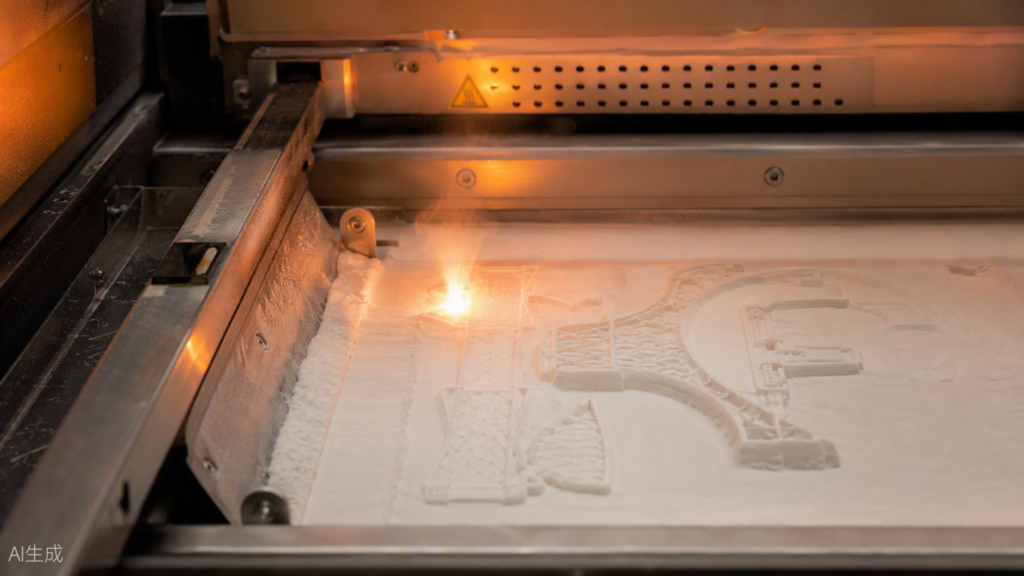
A laser sinters a fresh layer of nylon PA12 powder inside an SLS build chamber.
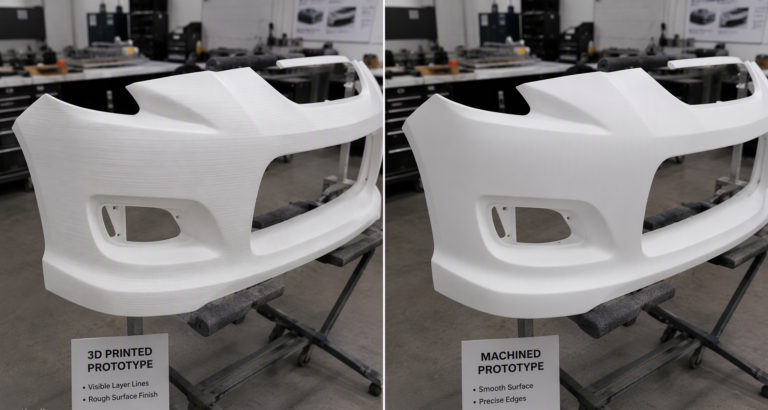
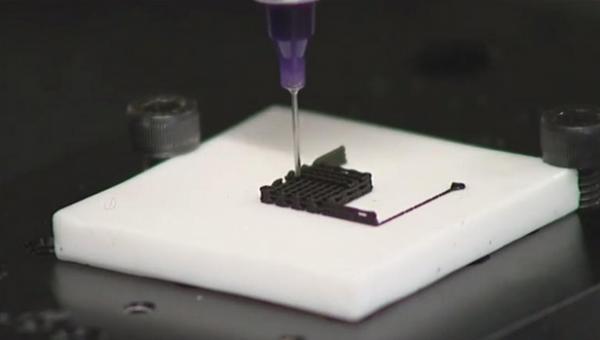
FDM/FFF (filament). The accessible route. Nylon filament prints at 220–250 °C nozzle temperature with a heated bed around 80 °C — non-negotiable, because nylon’s bed adhesion is notoriously poor without it. An enclosed chamber helps enormously. FDM nylon is ideal for jigs, brackets, and wear parts, though layer lines limit fine detail and Z-axis strength.
SLS (Selective Laser Sintering). A laser sinters PA12/PA11 powder layer by layer — no supports needed, since the unsintered powder cradles the part. The payoff: complex geometries, interlocking assemblies printed in place, and near-isotropic strength (SLS PA12 holds roughly 97–98% isotropy, with Z-axis tensile strength around 42 MPa where some FDM processes manage a fraction of that). Roughly 50% of unsintered powder can typically be refreshed and reused.
MJF (Multi Jet Fusion). HP’s process jets fusing and detailing agents onto the powder bed, then fuses with infrared energy — faster than SLS, with smoother surfaces and a higher powder reuse rate of around 70%, which directly lowers cost per part. For batch production of functional nylon parts, MJF has become the industry’s throughput king: hundreds of parts can be nested through the full build volume in a single run.
3. Applications: Where Printed Nylon Earns Its Keep
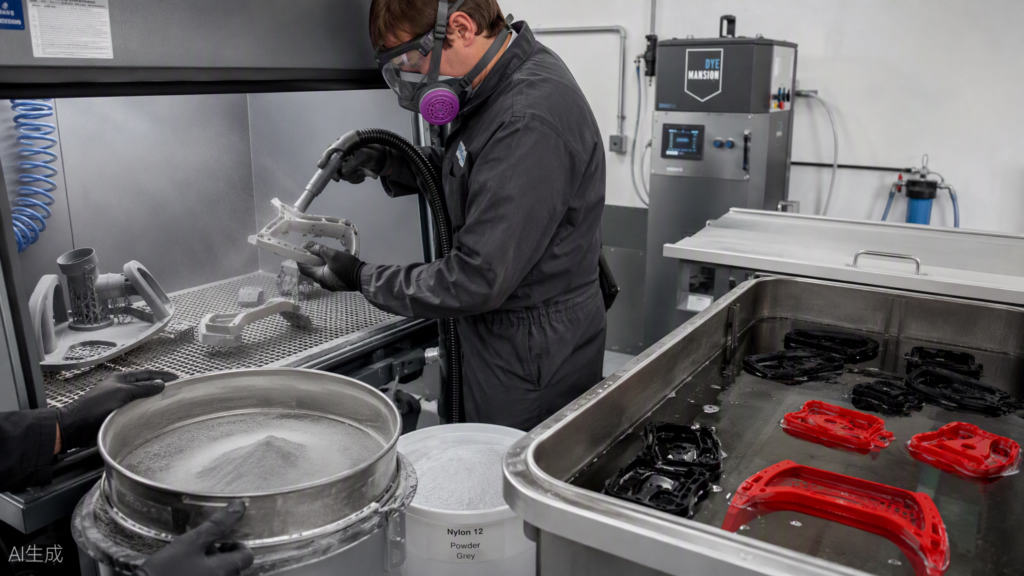
Post-processing: bead blasting, powder recovery, and dyeing of freshly printed nylon parts.
- Automotive & mobility: friction- and deformation-resistant parts, intake components, brackets and clips — glass-filled nylon has lightweighted parts like intake manifolds by ~40%.
- Gears, hinges & mechanisms: nylon’s low friction and fatigue resistance make it a natural for gears and snap-fit assemblies; PA11 is the go-to for living hinges.
- Medical & skin contact: biocompatible grades support prostheses, orthotics, and surgical guides with sub-millimeter accuracy.
- Consumer & industrial end-use parts: non-abrasive, paintable surfaces suit high-touch interiors, power-tool housings, and small-batch production that replaces injection molding outright.
The economics are part of the story: powder-bed nesting plus high refresh rates have driven real-world part costs down dramatically — documented cases show per-part cost falling by 80% when production moves to automated powder-recycling workflows.
4. The Pitfall Guide: Seven Mistakes to Avoid
1. Printing wet filament. Nylon is aggressively hygroscopic — a spool left out overnight can absorb enough moisture to cause stringing, bubbles, and weak layers. Dry at 70–80 °C for 4–6 hours and print from a sealed dry box. This single mistake ruins more nylon prints than all others combined.
2. Skipping the heated bed and enclosure on FDM. Without an ~80 °C bed (plus glue stick or a Garolite surface) and an enclosure, warping and layer splitting are nearly guaranteed.
3. Choosing PA12 when the part must flex. For snap fits and living hinges, PA11’s higher yield strain and ductility give you real headroom. PA12 is the rigid one — pick it for dimensional stability, not repeated bending.
4. Expecting molded-hinge life from printed hinges. Powder-bed living hinges survive tens of cycles (~30–50 is typical), not thousands. Keep hinge thickness around 0.3–0.8 mm (0.5 mm works well in MJF PA12), build so layers run across the hinge width, and consider hot-flexing the hinge before first use.
5. Ignoring powder refresh ratios. Quoting SLS/MJF parts without accounting for the required virgin-powder percentage inflates your real cost per part. Know your machine’s refresh rate before you price the job.
6. Forgetting moisture drift after printing. Even PA12 absorbs atmospheric moisture over time, and PA11 more so — parts can shift dimensionally and mechanically with humidity. Condition parts and tolerance accordingly for wet environments.
7. Overheating PA11 in air. PA11’s higher processing temperature makes oxidation a real risk; an inert atmosphere preserves both part properties and powder recyclability.
The Bottom Line
Nylon earned its place in additive manufacturing the old-fashioned way: by making functional parts that survive real use. Pick PA6 filament for tough desktop parts, PA12 powder for rigid, precise, production-grade components, and PA11 when the design must bend without breaking. Respect the moisture, respect the refresh rate, and nylon will quietly outperform almost everything else on the shelf.