


Wire EDM vs. CNC Machining: Two Very Different Ways to Cut Metal — and How to Choose Between Them
Force vs. sparks: how low-speed wire EDM and conventional CNC machining each dominate where the other struggles — and why the best shops use both.
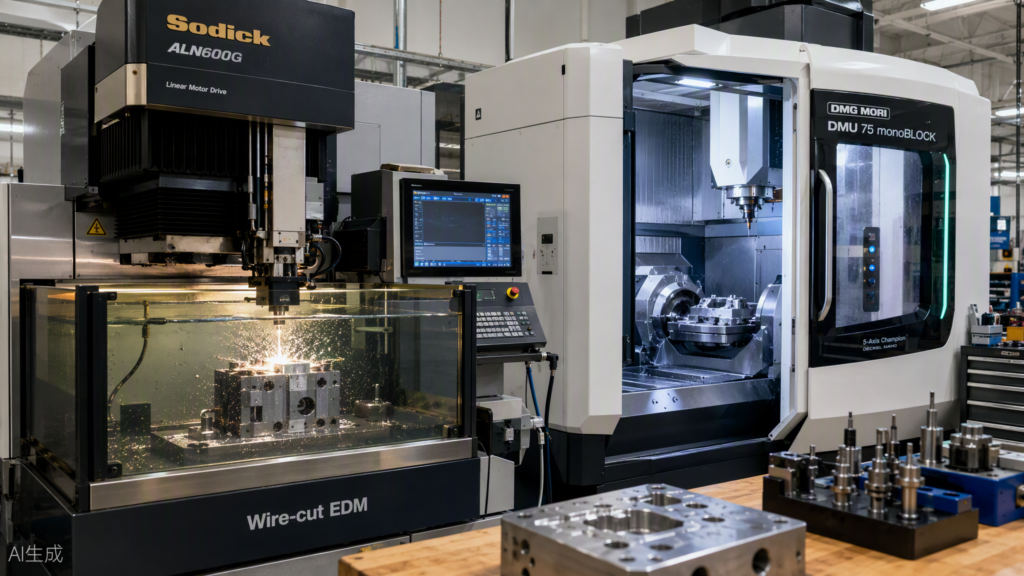
A precision tool-and-die shop: a wire EDM machine spark-cutting a die block beside a 5-axis CNC machining center.
Ask a mold maker how a hardened steel die gets its razor-sharp internal corners, and you’ll hear two answers: “the mill did the heavy lifting” and “the wire did the magic.” Wire EDM (known in China as 慢走丝, low-speed wire electrical discharge machining) and conventional CNC machining are the twin pillars of precision metalworking — but they cut metal in fundamentally different ways, and each dominates where the other struggles.
This guide explains how each process works, where each one wins, where each one falls short, and how professional shops combine them.
The Fundamental Difference: Force vs. Sparks
Обработка на станках с ЧПУ is a mechanical, subtractive process. A rotating cutter — an end mill, face mill, or drill — physically shears chips off the workpiece. It’s fast, versatile, and handles everything from aluminum to plastics. But that cutting force is also its weakness: tools deflect, thin walls bend, and hard materials destroy expensive cutters.
Wire EDM never touches the part at all. A hair-thin brass or copper wire (typically 0.02–0.30 mm) travels in one direction through the workpiece while pulsed electrical sparks — reaching 8,000–12,000 °C — erode the metal along the programmed path. The whole process happens submerged in deionized water, which flushes away debris and controls heat. Because there is zero cutting force, the part experiences no mechanical stress, no burrs, and no tool marks.
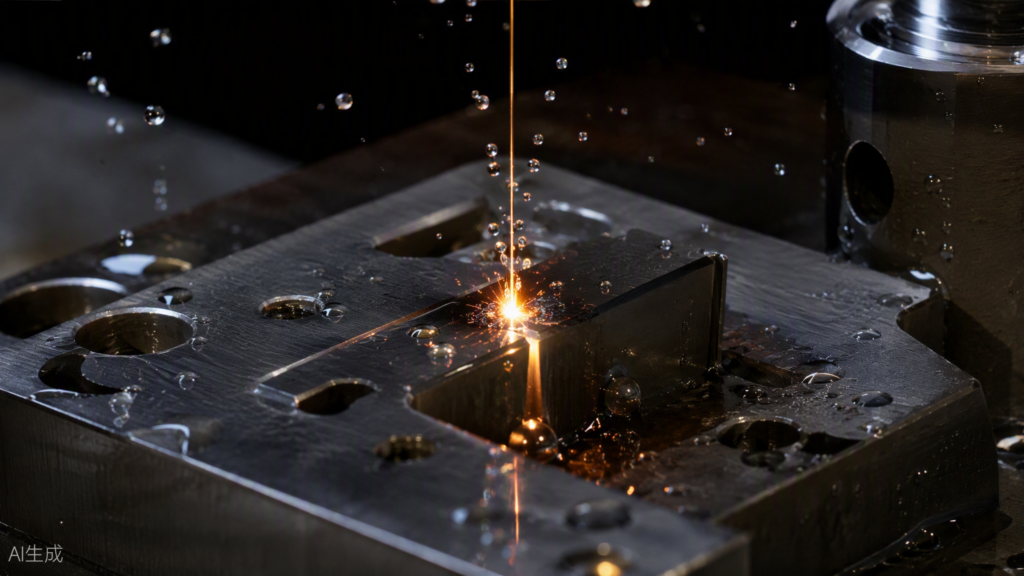
Wire EDM close-up: a hair-thin brass wire spark-erodes hardened steel submerged in deionized water.
Wire EDM (Low-Speed Wire Cut): Strengths and Weaknesses
How it works in practice: the wire electrode runs one-way at 0.2–0.8 m/s and is discarded after a single pass — every millimeter of cut uses fresh, unworn wire, which is a key reason for its legendary consistency. Multi-pass strategies (“one rough cut + three to four skim cuts”) progressively refine accuracy and surface finish.
Advantages
- Extreme accuracy: tolerances of ±0.002–0.005 mm are routine; ultra-precision machines reach ±0.001 mm. No tool deflection means the cut is perfectly straight from top to bottom of the part.
- Hardness is irrelevant: if it conducts electricity, the wire cuts it — hardened tool steel at 60+ HRC, carbide, titanium, Inconel, tungsten. You can heat-treat first and machine after, eliminating distortion risk.
- Sharp internal corners: minimum internal radius around 0.05–0.15 mm versus the full tool radius a mill must leave. Square holes, tiny slots, and intricate gear profiles come out crisp.
- Superb surface finish: Ra 0.4–1.6 μm in a single pass, down to Ra 0.1–0.3 μm with skim cuts — often good enough to skip polishing entirely.
- Delicate parts are safe: thin walls, needle-thin sections, and fragile features survive because nothing pushes on the part. Machines also run unattended for lights-out production.
Disadvantages
- Slow material removal: typically 20–80 mm²/min in finishing passes — hopeless for roughing a large block.
- Conductive materials only: no plastics, no ceramics, no composites.
- Through-cuts by nature: the wire must pass completely through the workpiece, so blind pockets and true 3D sculpted surfaces are off the table (taper cuts up to 30°+ are possible).
- Consumables and cost: brass wire, deionized water, and filters add up, and the machines themselves are major investments.
- A recast layer: spark erosion leaves a thin heat-affected surface layer that may need attention in fatigue-critical aerospace parts.
CNC Machining: Strengths and Weaknesses
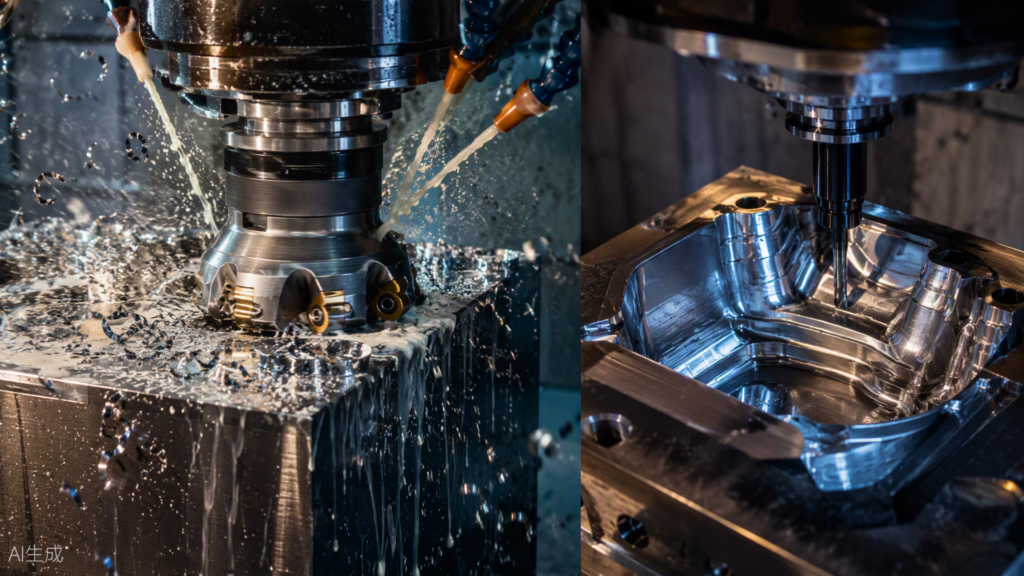
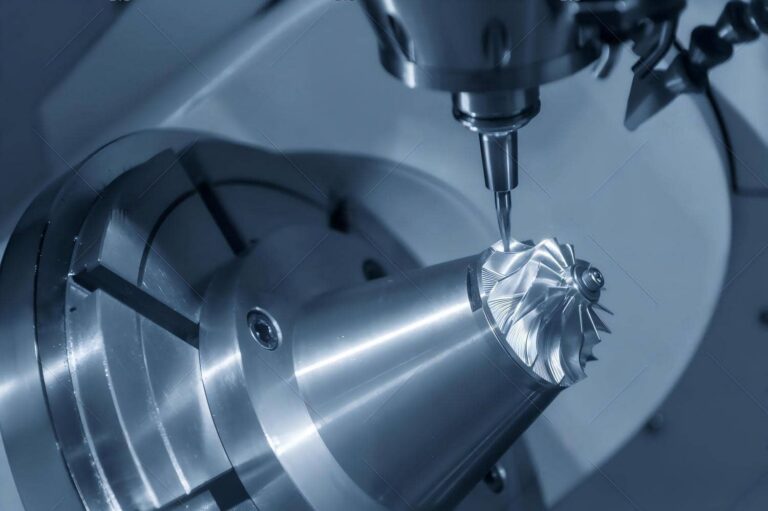
CNC milling: bulk roughing with a face mill (left) and 3D cavity finishing with a small end mill (right).
Advantages
- Speed where it counts: nothing removes bulk material faster. Roughing a mold block on a machining center takes a fraction of the time any EDM process would need.
- True 3D capability: 3- to 5-axis milling sculpts freeform surfaces, deep cavities, draft angles, and compound curves that wire EDM simply cannot produce.
- Any material: metals, plastics, composites, wood, foam — no conductivity requirement.
- Lower cost for simple geometry: for straightforward parts in soft materials, milling is faster, cheaper, and needs no special dielectric infrastructure.
- No start holes required: wire EDM needs a pre-drilled entry hole for every internal contour; a mill just plunges in.
Disadvantages
- Tool deflection and chatter: as cutters push into the material, they flex — the enemy of tight tolerances on deep or slender features. Holding better than ±0.01–0.02 mm on hard, complex parts gets genuinely difficult.
- Hardness costs money: above ~40 HRC, tool life plummets, speeds drop, and specialized carbide tooling becomes a major expense.
- Rounded internal corners: a rotating round tool physically cannot cut a square internal corner — the corner radius always equals at least the tool radius.
- Cutting force distorts delicate parts: thin walls and fine features can bend, vibrate, or chatter under tool pressure.
- Tool marks: milled surfaces usually show witness lines, and mirror finishes require secondary polishing.
Head-to-Head Comparison
| Factor | Wire EDM (Low-Speed Wire Cut) | Обработка с ЧПУ |
| Cutting principle | Thermal erosion by spark (non-contact) | Mechanical shearing (cutting force) |
| Typical tolerance | ±0.002–0.005 mm (best ±0.001) | ±0.01–0.05 mm typical |
| Surface finish (Ra) | 0.1–1.6 μm, near-ground finish | 0.8–3.2 μm as-machined |
| Min. internal corner radius | ~0.05–0.15 mm | ≥ tool radius (typically ≥0.4 mm) |
| Material hardness limit | None — cuts 60–70 HRC easily | Efficiency drops sharply above ~40 HRC |
| Material range | Conductive metals only | Virtually anything |
| 3D freeform surfaces | No (2D profiles + taper) | Yes — full 3D, 5-axis |
| Bulk removal speed | Slow | Very fast |
| Thin-wall / delicate parts | Excellent — zero force | Risk of distortion |
| Consumables | Wire, DI water, filters | Cutting tools, coolant |
| Best batch role | Finishing, precision features | Roughing, general shaping |
When to Choose Which — and Why the Best Answer Is Usually “Both”
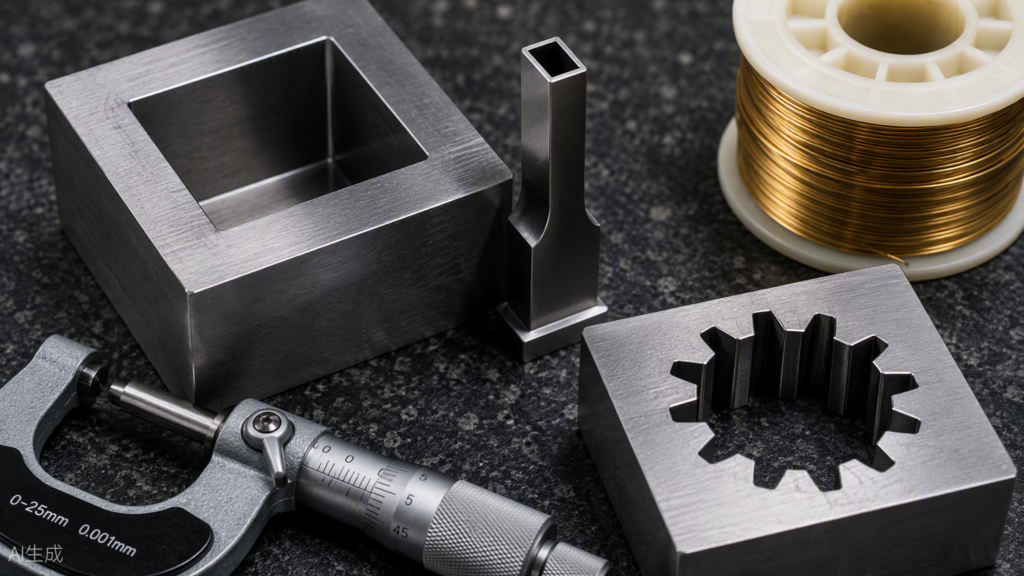
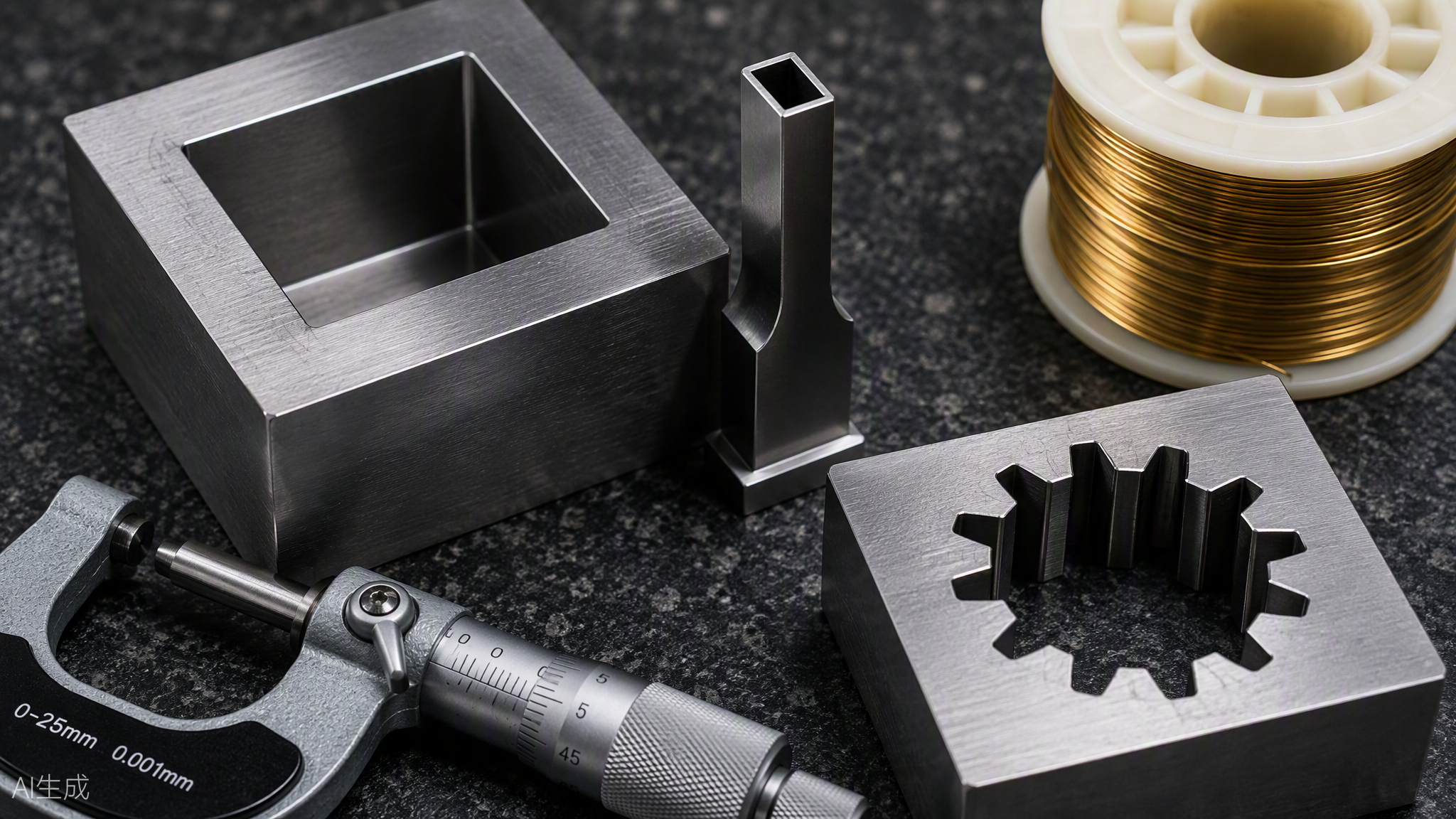
Wire EDM results: a mold insert with near-perfect square internal corners, a precision punch, and a gear-profile die opening.
Choose wire EDM when:
- Internal corners must be nearly square (radius < 0.15 mm)
- The part is hardened steel, carbide, or another difficult alloy above 40 HRC
- Tolerances are in the single-digit microns, or the surface must be polish-free
- Thin walls, micro features, or delicate geometry can’t survive cutting forces
- You’re making stamping dies, mold inserts, precision punches, gears, or medical/aerospace components
Choose CNC machining when:
- Large volumes of material must come off quickly
- The part has 3D sculpted surfaces, deep cavities, or complex draft
- Material is aluminum, mild steel, plastic, or anything non-conductive
- Geometry is simple and budget matters
- You need threads, blind pockets, or bored holes
The professional workflow is a hybrid. Rough the part on a CNC machining center while the steel is soft → heat-treat to full hardness → let wire EDM cut the precision profiles, sharp corners, and tight-tolerance features. The mill provides the speed; the wire provides the perfection. This is exactly how modern injection molds, stamping dies, and aerospace tooling are built.
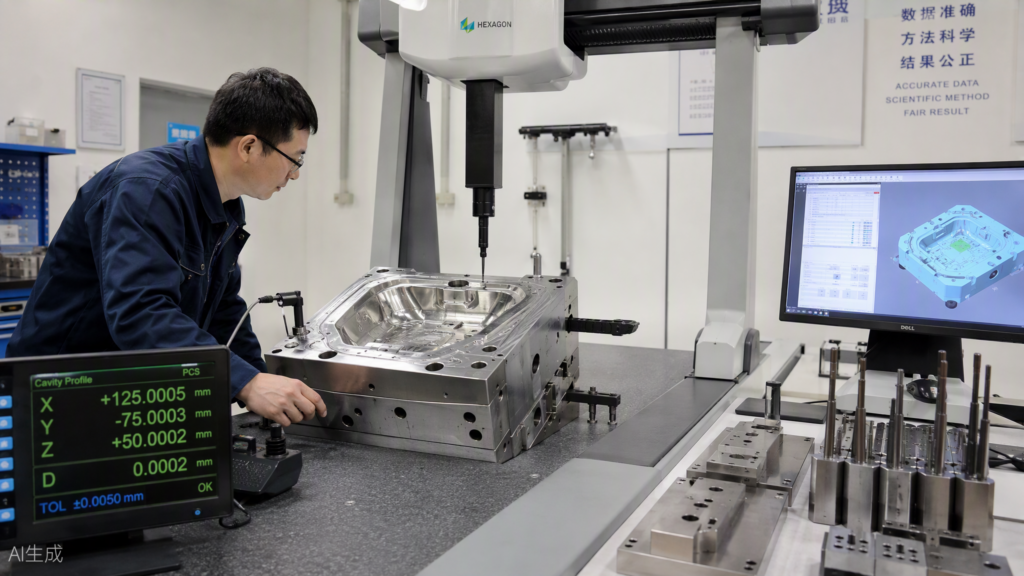
Final verification: CMM inspection of a finished injection mold holding micron-level tolerances.
Суть дела
Wire EDM and CNC machining aren’t competitors — they’re complementary tools answering different questions. CNC asks “how fast can we remove this material?”; wire EDM asks “how perfectly can this feature be made?” Knowing which question your part is really asking is the difference between an economical job and an expensive mistake.
Have a part with tight tolerances, hard materials, or sharp internal corners? Send us your drawings (STEP/IGES/PDF) with tolerance and material requirements — our engineers will recommend the right process mix (3/4/5-axis CNC machining + wire EDM) and return a free DFM review and quotation within 24 hours.
UtelyMachine — precision CNC machining and wire EDM services for molds, dies, and critical metal components. Visit us at www.utelymachine.com.